Robert Jewett’s door-stopper of a commentary on Romans (Minneapolis MN: Fortress Press, 2007). 2.255 kg or just under 5 lbs, 1144 pages. In his preface he notes that he worked on it for twenty-five years.
Introduction
As advertised, this morning I will talk a bit about Paul’s Letter to the Romans. Over the next six weeks five of the first non-Gospel readings will be from Romans, so I will focus on that Letter in my preaching.
The interpretation of this letter has been contested over the centuries, and this disagreement has had some serious consequences. Martin Luther’s lectures on Romans in 1515-16 led directly to his formulation of the 95 Theses and the unexpected launch of the Protestant Reformation. Arguably, differences over how to read Romans have contributed to the violence of the Peasants War in the Holy Roman Empire (1524-25), the Thirty Years War (1618-1648), the English Civil Wars (1639-1653), Wars of Independence in the Netherlands (1566-1648), among others. So, some have taken it very seriously, to the point of arming in militias and armies to defend its principles.
Catholics and Protestants no longer take up arms to settle their issues, but Romans continues to be a disputed text. Some serious ink has been spilled and large forests have been processed into paper in order to publish comments on the letter. Above is a picture of Robert Jewett’s 2007 commentary, which I read through shortly after it came out, and which has influenced me significantly. Historically, Karl Barth’s The Epistle to the Romans was published in German in 1918, and launched the school of theology known as Neo-orthodoxy. Barth subsequently revised and expanded the book, so that there were no fewer than six editions. Despite its prominence in the New Testament and its significance to the Protestant Reformation, some issues defy consensus, as witnessed by the title of Mark Nanos’s book The Mystery of Romans: The Jewish Context of Paul’s Letter (Minneapolis MN: Fortress Press, 1996).
I intend in this sermon to give a brief introduction to the Letter to the Romans, and then comment a bit on the reading today from Romans 4:13-25.
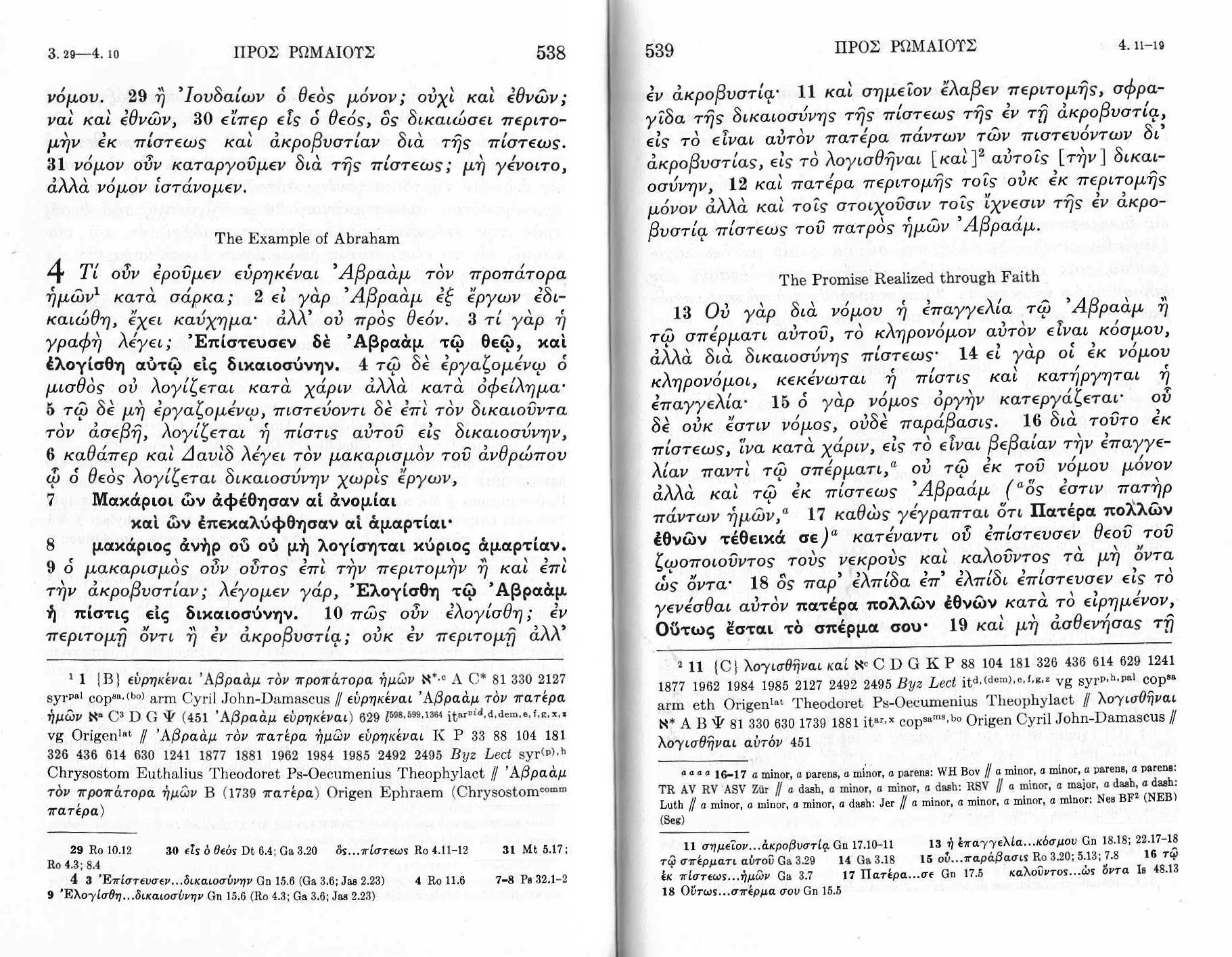
Romans 3:28b-4:19a from The Greek New Testament, Third Edition (Münster, West Germany: United Bible Societies 1975), commonly known as USB3. Chapters and verses date from the Early Modern Era – the beginning of the era of printing in Europe. The first version of the Bible to use the chapters we use now dates from 1551, and the first to incorporate verses in the Hebrew Bible/Old Testament is from 1450, and the New Testament in 1553. Chapters and verses are tools to find one’s way around a text, and not part of the original.
Fun Facts
The Letter to the Romans is long – 16 chapters, over 7000 words. Paul did have a tendency to write long letters – First Corinthians and Second Corinthians are also long, and Philippians and Galatians are several chapters long – but Romans was the longest. Paul could write briefly – Philemon was probably on one sheet of papyrus. I do not know about you, but even back in the day I did not often write letters that long. George Kennan’s “Long Telegram” from 1946 – the longest diplomatic telegram ever sent in the history of the US State Department, and which laid out the policy containment for the USA towards the Soviet Union over the next forty-five years – was five thousand words long.
Paul’s Letter to the Romans‘ purpose not as clear as it might have been. Some suggestions coming from the text include (and they are not necessarily mutually exclusive):
“I’m coming to you as I go to take the good news Spain. Please welcome me.” Romans 15:22-29
“I’ve heard that there are some divisions amongst you. Stick together, don’t judge, and don’t be so proud.” Romans 2:1, 15:1-2, 16:7
“I want to talk to you about faith and works, Law and Gospel, so listen carefully.” Romans 2-11
“I want to talk to you about what I understand is the extension of the good news of Jesus to the Gentiles, but that does not overturn the promises God made to Abraham, Jacob, and Israel.” Romans 9-11
“Here’s a long list of people to whom I want to say hello.” Romans 16:1-16
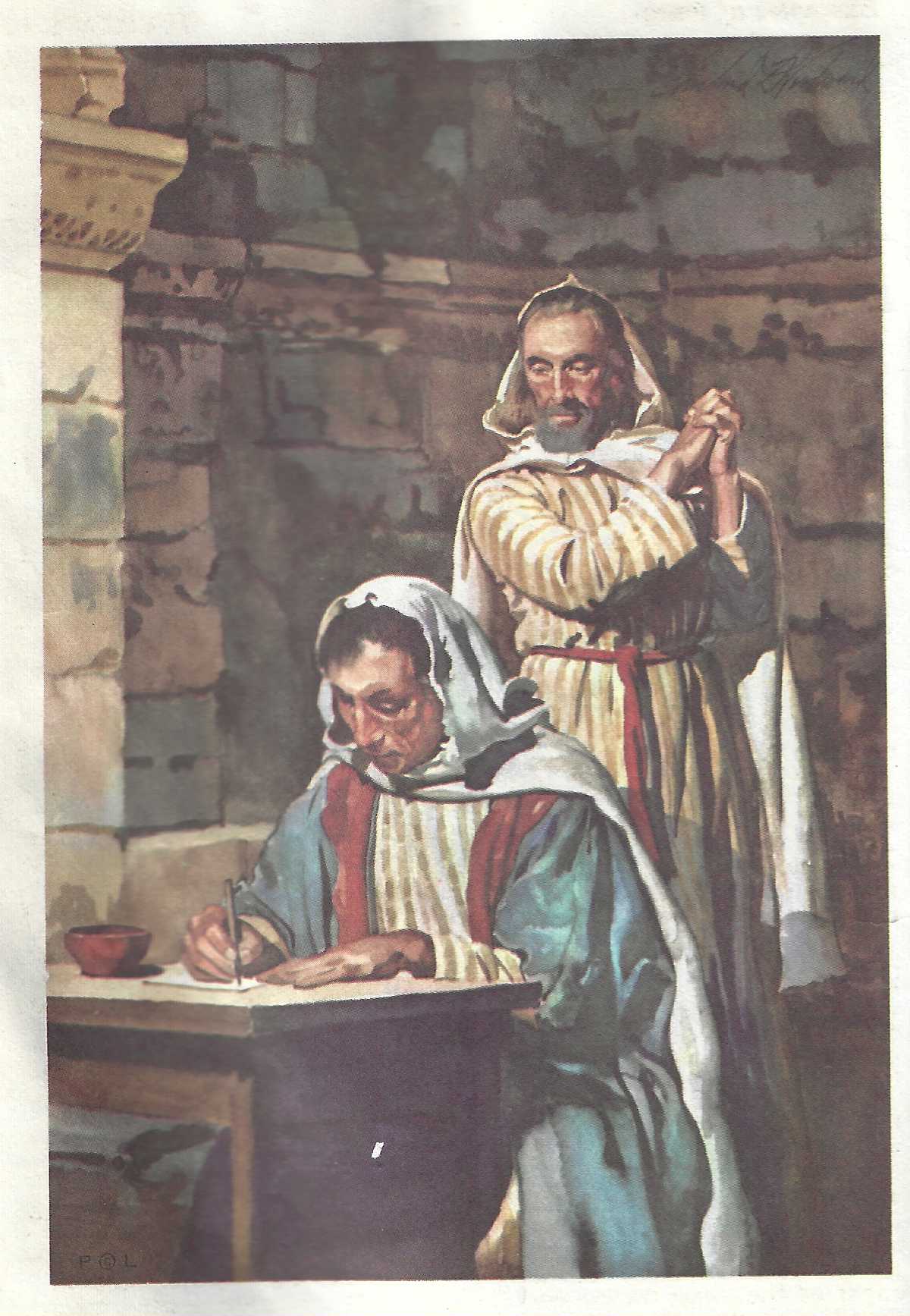
Paul dictated the letter, and it was written by a scribe named Tertius (Romans 16:22). It was meant to be read by someone who had studied it and could read it aloud accurately, so most people undoubtedly encountered it aurally. Given the length, listening to the whole thing might have taken forty-five minutes to an hour.
The language is Koine Greek. Already by the First Century Greek had lost the tonal quality of Classical Greek, and sounded much like Standard Modern Greek. The grammar of the Greek language has changed significantly in twenty centuries since, but a modern Greek speaker can still make sense of it. It’s a bit like us English-speaking people trying to understand Chaucer in the original.
The letter shows great evidence of an understanding of oral rhetoric and its use (see especially Jewett’s commentary, which gets into a score of things which most of us text-based people miss). The rhetoric suggests that it is aimed at persuading the audience to the author’s argument; to consider it like an academic text-book is anachronistic.
The oldest copies that we have now are manuscripts, sometimes complete, sometimes in fragments, written on vellum or papyrus. The manuscript known as P46, partly housed at the Chester Beatty Library in Dublin (where I saw it on dissplay), is the oldest known manuscript, dated to around 200 CE.
The Promise Rests on Grace
For this reason it depends on faith, in order that the promise may rest on grace and be guaranteed to all his descendants, not only to the adherents of the law but also to those who share the faith of Abraham (for he is the father of all of us, as it is written, “I have made you the father of many nations”). Romans 4:16
Today’s passage from Romans comes in Chapter Four. Paul has already said a lot. He begins in Chapter One with a great long introduction: worth reading:
Paul, a slave of Jesus Christ, called to be an apostle, set apart for the gospel of God, which he promised beforehand through his prophets in the holy scriptures, the gospel concerning his Son, who was descended from David according to the flesh and was declared to be Son of God with power according to the spirit of holiness by resurrection from the dead, Jesus Christ our Lord, through whom we have received grace and apostleship to bring about the obedience of faith among all the Gentiles for the sake of his name, including yourselves who are called to belong to Jesus Christ Romans 1:1-7
This is a subversive introduction. Paul humbly acknowledges that he is a slave of Jesus Christ, but pointedly does not mention his Roman citizenship. Roman citizenship was something significant and which conferred rights and status above non-citizens. As might be expected, the proportion of citizens to the whole population was highest in the city of Rome, where it would have been 55%, although in the eastern Roman Empire, from which Paul came, it might have been as low as 1%; given that many of the members of the House Churches in Rome were Greek-speaking Jews and Gentiles, who presumably did not have deep roots in the city, the proportion of citizens among them may have been lower than among the Latin-speaking population in the city generally. The only case in which claiming to be a slave of someone conferred status was if one claimed to be the slave of the Emperor. In that case if they were acting or saying something, they were doing so on behalf of the Emperor. By claiming to be a slave of Jesus Paul subverts the power hierarchy of the Empire. He furthers his claim to authority within the church by describing himself as called to be an apostle (one who is sent), which was a special class of disciples. Paul knows who he is and whose he is.
The second half of Chapter One gets into apocalyptic language: “the wrath of God is revealed from heaven against all ungodliness and injustice of those who by their injustice suppress the truth.” Paul understands that from the time of Creation human beings had the rational ability to know God as their Creator (and thus laying the foundation of Natural Theology so beloved of Thomas Aquinas). However, they went down paths that led them away from the Creator. They “exchanged the glory of the immortal God for images resembling a mortal human or birds or four-footed animals or reptiles.” The result of this idolatry is that they become depraved:
They were filled with every kind of injustice, evil, covetousness, malice. Full of envy, murder, strife, deceit, craftiness, they are gossips, slanderers, God-haters, insolent, haughty, boastful, inventors of evil, rebellious toward parents, foolish, faithless, heartless, ruthless. They know God’s decree, that those who practice such things deserve to die, yet they not only do them but even applaud others who practice them. Romans 1:29-32
So, idolatry leads to sinful, horrible behaviour. I find it interesting that this is not the story of the Fall as we have it in Genesis 2-3, not about Adam and Eve, but rather a story of how bad reasoning led to idolatry, and idolatry led to depravity. Like most Jews of his time, Paul viewed the Gentiles as extremely depraved, and this depravity was part and parcel of the Roman Empire.
At the beginning of Chapter Two Paul plays a rhetorical trick on his readers:
Therefore you are without excuse, whoever you are, when you judge others, for in passing judgment on another you condemn yourself, because you, the judge, are doing the very same things. Romans 2:1
Clearly he is accusing those listening in the various house churches in Rome of being judgemental. Who are they judging? Perhaps Jewish Christians, perhaps the larger community of Jews, perhaps Jewish Gentiles who obswrve some or all of the Torah. It does seem that the letter is addressed to Gentiles who feel superior to another group.
In Romans Chapter Fourteen Paul writes,
Welcome those who are weak in faith but not for the purpose of quarreling over opinions. Some believe in eating anything, while the weak eat only vegetables. Those who eat must not despise those who abstain, and those who abstain must not pass judgment on those who eat, for God has welcomed them. Who are you to pass judgment on slaves of another? It is before their own lord that they stand or fall. And they will be upheld, for the Lord is able to make them stand.
Some judge one day to be better than another, while others judge all days to be alike. Let all be fully convinced in their own minds. Those who observe the day, observe it for the Lord. Also those who eat, eat for the Lord, since they give thanks to God, while those who abstain, abstain for the Lord and give thanks to God . . .
Why do you pass judgment on your brother or sister? Or you, why do you despise your brother or sister? . . .
Let us therefore no longer pass judgment on one another, but resolve instead never to put a stumbling block or hindrance in the way of a brother or sister. Romans 14:1-6, 10a, 13
This is not the first time he has found himself obliged to tell a group of people to smarten up. In Paul’s First Letter to the Corinthians he hears that there are divisions, for a couple of reasons. First, in chapters two to four he hears that some people are claiming to be better because they had a baptism from Apollos, or Paul, or Peter (Cephas), or Christ. Paul berates them for this. He concludes by stating:
So let no one boast about people. For all things are yours, whether Paul or Apollos or Cephas or the world or life or death or the present or the future—all are yours, and you are Christ’s, and Christ is God’s. First Corinthians 4:21-23
Later in First Corinthians Chapters 12 to 14 he talks about spiritual gifts, and he has also heard that some of them, because they speak in tongues, believe themselves to be more gifted than others. Again he challenges them, and asserts that tongues are wonderful, but clear preaching or prayer in understandable language is better, and that love cancels out any sense of being better than other.
Love is patient; love is kind; love is not envious or boastful or arrogant or rude. It does not insist on its own way; it is not irritable; it keeps no record of wrongs; it does not rejoice in wrongdoing but rejoices in the truth. It bears all things, believes all things, hopes all things, endures all things. 1 Corinthians 13: 4-7
Romans appears to be similar, only instead of people feeling superior because of who baptised them or because of how spiritual gifts are manifested among them, Paul is critiquing them because it appears some in Rome thought they were stronger than others, namely, that they had a freedom in Christ while others felt bound by Torah commandments.
Starting in Romans Chapter Two Paul begins a long description of the benefits and challenges of the Torah and of being the people of Israel. Paul in Philippians 3:6 describes himself before he knew Jesus “as to righteousness under the law, blameless,” but he is happy to let go of any pride he had in that compared to the knowledge that he has received the free grace of God through Christ.
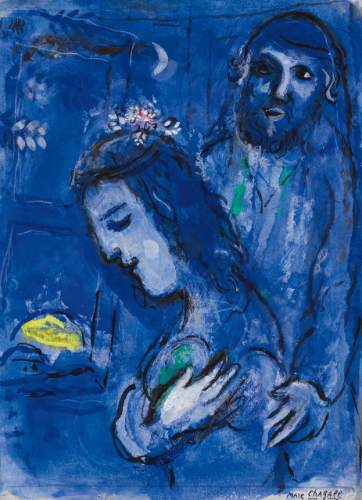
Abraham and Sarah (1956) by Marc Chagall (1887-1985)
In today’s reading Paul brings up Abraham, to whom God made promises. Abraham lived long before the giving of the Torah on Mount Sinai. Thus, he is like the Gentile followers of Jesus, in that they are not bound by the Torah, but have a faith that saves. Abraham received his promises, but not because of anything he had done. His obedience was in response to the free gift, a covenant made between him and the Lord God, but that is not what made him righteous. His righteousness was a fift of God – grace. Paul pushes the text of Genesis 15 to make Abraham the father not only of Isaac, the grandfather of Israel, but of all nations – including English, Irish, Scots, Welsh, Greeks, Americans, and even Canadians. His faith, his belief, is not simply assent to some proposition, but a kind of experienced trust, even in the face of what seems impossible. For us who are Christians this has already been accomplished for us by Jesus in that we and our sins die with him on the cross, and we are raised with him to a new life and we are viewed and renewed as if we were with him reigning from on high.
So you can see where being judgemental is problematic. It suggests that one is falling back into old ways: Paul is suggesting that the Gentile followers in Rome may be no better than their old selves – filled with every kind of injustice, evil, covetousness, malice, full of envy, murder, strife, deceit, craftiness, gossip, slander, God-haters, insolent, haughty, boastful, inventors of evil, rebellious toward parents, foolish, faithless, heartless, ruthless. He’s not mitigating this in any way. Paul’s remedy for being judgemental is to be humble and recognise that we are saved by the free gift of God which is given to us by the faithfulness of Jesus and lives in us by his Spirit by evidence of faith, gentleness, care, love, humility, and generosity.
Invitation:
We are adopted children of Abraham, grafted onto the vine of Israel. Let us not become arrogant in our faith, for it is the faith of Jesus. Let us not denigrate others, such as Jews, for God loves them as well. Let us work for justice and peace and reconciliation, for that is what our Lord did and has accomplished in Christ Jesus. Remember that “it depends on faith, in order that the promise may rest on grace.”
A modern painting of a young Martin Luther nailing his Ninety-Five Theses to the door of All Saints Church, Wittenberg, then in the Electorate of Saxony in the Holy Roman Empire.
Introduction
This morning I want to focus on the reading from Paul’s Letter to the Romans. In particular, I want to consider the first verse from Chapter Five: “Therefore, since we are justified by faith, we have peace with God through our Lord Jesus Christ . . .”
These words are central to the thought of Martin Luther (1483-1546). As a result of his careful reading of Paul’s Letter to the Romans he wrote his Ninety-Five Theses (1517), which set off the Protestant Reformation and transformed Europe.
I will attempt to stick to talking about this for just fifteen minutes, but to be honest, to give the topic its due, I should lecture for an hour now and then have you come back twice weekly for the next twelve weeks; I suspect that is not possible, so I will just preach now. But, I assure you, the reading and interpretation of Paul’s Letter to the Romans is that complex and that important, both in Christian and European history as well as in Christian theology.
What I will do is present two rather different approaches to this passage from Romans, first Luther’s own reading, and then a later, modern reading that comes from what has been call “The New Perspective on Paul”. Then I will connect this to the gospel reading from Matthew, and speak of how this might be relevant to us today.
The Textbook Approach
This letter is truly the most important piece in the New Testament. It is purest Gospel. It is well worth a Christian’s while not only to memorize it word for word but also to occupy himself with it daily, as though it were the daily bread of the soul. . . St. Paul, in writing this letter, wanted to compose a summary of the whole of Christian and evangelical teaching. Martin Luther, Preface to Romans(1522), translated by Andrew Thornton, for the Saint Anselm College Humanities Program. (c)1983 by Saint Anselm Abbey.
As the above quotation suggests, Martin Luther saw the Letter to the Romans (also called the Epistle to the Romans) as the preeminent text in the New Testament, a light that enlightens everything else. I well remember the Evangelical historian James Packer (1926-2020), following Luther, describing it to an Anglican Essentials Conference around 2001 in Langley BC as the key to understanding the Bible.
This is what I would describe as the “textbook” approach to reading Romans. It imagines Paul trying to tell his hearers and readers the core of the good news of Jesus Christ. Luther writes that it is “the richest possible teaching about what a Christian should know: the meaning of law, Gospel, sin, punishment, grace, faith, justice, Christ, God, good works, love, hope and the cross.” While there may have been an occasion and reason for Paul to write this particular letter to the house churches in Rome, this recedes into the background as one considers its universal importance.
Martin Luther was an Augustian Friar (the same as Pope Leo XIV, five centuries later). Before entering the friary he was trained as a lawyer. He subsequently studied scripture and theology, becoming a Doctor of Theology and professor in 1512. He began lecturing on Romans in 1515-1516, posted his 95 Theses in 1517, and it was promptly published in Latin and German. That new technology, the printing press, meant that his ideas had a rapid impact across the Holy Roman Empire. The Pope excommunicated him in 1520. Luther wrote his brief Preface to Romans in 1522. The Reformation was off and running, and various states adopted what became known in German as the Evangelische Kirche (in the Anglosphere, Lutheranism). Other reformers followed Luther’s lead but developed their own approaches, especially in Switzerland, with Jean Calvin publishing his Institutes of the Christian Religion in 1536.
Therefore being justified by faith, we have peace with God through our Lord Jesus Christ: By whom also we have access by faith into this grace wherein we stand, and rejoice in hope of the glory of God. Romans 5:1-2 AV/KJV (1611)
Martin Luther read Romans 5:1-2 as a key text. As someone trained in law, he read the phrase “justified by faith” in a legalistic way. Justification for Luther means “to be made just” in the eyes of God. However, since “all have sinned and fallen short of the glory of God” human beings are incapable of being just on their own merits, or by their good works. Whatever motivation they might have to do good things, they are also motivated to do bad things, or leave undone those things which they ought to have done. Thus we are, as Calvin put it later, a “massa damnata”, a damned mass of humanity. However, the gospel, the good news of Jesus Christ, reveals that in his suffering and death Jesus has paid the penalty of sin for us, and that our sins have died with him. If we hear the word of God and the grace – free gift of forgiveness – offered by believing in this, then by faith we are made just, and by the Holy Spirit we are empowered by love to do good works.
Context is important. Martin Luther lived in one of the most penitential of ages. People were often convinced of their personal sinfulness and of the sins of humanity. Penance was a regular practice, the confession of one’s sins to a priest, followed by being given a particular penance. It was thought that by doing this regularly one could forgo time in Purgatory, that liminal space on the doorstep of heaven where saved souls purged themselves of all unspiritual character. This could also be done by pilgrimages to holy places, or by engaging in crusades. By the 16th Century these indulgences had been commodified – by paying money, instead of actually performing a penance or going on a pilgrimage, one could receive remission for one’s sins (and along the way help to pay for the building of the new St Peter’s Basilica in Rome).
Luther’s insight was that if one had faith all of this industry of penance was irrelevant and misleading. people should not be focused on their efforts to receive remission of sins by their works, but on their faith and to trust that God sees them as justified, even if they continued in occasional sinful acts. God could not be bought off – that would impugn the gracious majesty of the divine as well as the satisfaction offered by Jesus in his death.
So strongly did Luther feel about the singular importance of faith that when he translated the New Testament into German in 1522 (he published the rest of the Bible in 1534) he translated Romans 5:1 as “Therefore being justified by faith alone,” adding that word alone in German, allein. He justified this on the grounds that ordinary German required it. From the Latin this principle of “faith alone” was known as sola fide.
Thus, Lutherans will emphasise the event of justification, which comes in baptism and is manifested in the faith of a believer; Evangelicals will tend to diminish the sacramental importance of baptism, seeing it mainly as a sign, and will highlight the actual event of the coming to faith in Christ. The danger here is that the faith of an individual can thus be perceived as a kind of work of the intellect, and many Evangelicals forget about the absolute givenness of grace and worry about whether their faith is sufficient or of the right sort; ironically, this shifts attention from the action of God in Christ to the intellectual probity of the individual Christian. A proper Lutheran approach would understand that even faith itself is a gift from God. A Catholic understanding (and Orthodox, as well) would understand a more dynamic approach to faith, where faith, while originating in the prevenient grace of God, is subsequently formed by good deeds.
The Reformation resulted in the Roman Catholic Counter-Reformation. When it came to faith versus works, in some circles Catholics bore down on the efficacy of good works, and reveled in indulgences. In more recent times Catholic theologians have considered the Lutheran point about faith more deeply, and the Joint Declaration on the Doctrine of Justification by The Lutheran World Federation and the Roman Catholic Church (1999) notes that, for Catholics,
good works, made possible by grace and the working of the Holy Spirit, contribute to growth in grace, so that the righteousness that comes from God is preserved and communion with Christ is deepened. When Catholics affirm the “meritorious” character of good works, they wish to say that, according to the biblical witness, a reward in heaven is promised to these works. Their intention is to emphasize the responsibility of persons for their actions, not to contest the character of those works as gifts,or far less to deny that justification always remains the unmerited gift of grace. (Para. 38; 4.7)
It is probably absolutely correct to say that Paul believed that people were saved from the justifiable wrath of God by the grace of God – the free gift of forgiveness in Christ Jesus. Catholics and Protestants agree on this. However, whereas Protestants (and among them, Evangelicals) would emphasise faith alone, sola scriptura, Catholics and Eastern & Oriental Orthodox would call attention to how faith in the believer is formed by doing good works. Luther sees faith as a singular event, whereas Catholics and Orthodox see it as a dynamic evolving thing, one that might begin as a infant at baptism and be appropriated as one grows up, and repeatedly renewed at the sacrament of the Holy Eucharist. Given that Catholics make up about 50% of all Christians, and Orthodox another 12%, I would argue that it would be sheer arrogance to dismiss 1.5 billion people as all being misled.
Luther’s approach, then, is one way to read Romans 5. Certainly, it is a popular and revolutionary one. In the reign of Elizabeth I it was adopted as Article XI of the Church of England’s Articles of Religion: Wherefore that we are justified by faith only is a most wholesome doctrine, and very full of comfort. To this day sola scriptura remains central to Evangelical thought. So if this is the faith as you understand it, then you stand in a great tradition.
But did Luther get it right? Is there another way (or other ways) to read Romans?
An ancient room underneath the Basilica of Santi Giovanni e Paolo al Celio in Rome, believed to have been used for prayer by early Christians. The complex of rooms, excavated in the 19th century, date from the first to the fourth centuries. They represent some of the best preserved domestic buildings from ancient Rome, and give one an idea of what a House Church in Paul’s time might have looked like.
Historical-Critical Approaches
In the past five-hundred years – the time since Martin Luther began the Reformation with his reading of Romans – the study of scripture has developed. Much of this work since the 18th Century has been done by pastors and scholars in the Lutheran tradition. Starting with the Enlightenment some scholars began to use the methods of historical literary criticism to understand Holy Scripture; putting aside the question of divine inspiration, it is manifest that these are texts written by human beings, and so should be susceptible to the techniques of literary and historical criticism. Following G. W. F. Hegel, scholars began to perceive that stories, doctrines, interpretations, and ideas evolve through history. Recognising that there are always multiple ways of reading a text, they began to live with the ambiguity. Academia might move towards a consensus, but there will always be differences. Using various methodologies – text criticism, form criticism, rhetorical criticism, source criticism, sociology, anthropology, archaeology, and history, we in the 21st Century have many more tools at hand when attempting to figure out what was happening in First Century Christianity and Early Christian Texts such as Romans.
When it comes to the Letters of Paul, there have been several revolutions.
One of them is to recognise that if we want to have a biography of Paul, we need to start with the Letters, as they are primary documents. Most understandings of Paul have been drive by the biography in The Acts of the Apostles, but it is a secondary source, written as it was by an anonymous author some forty years after the Letters (although it is traditionally attributed to Luke). The author had his own intentions in writing it, and among other things, he plays down the conflict between Paul and Peter (evident in Paul’s Letter to the Galatians and also emphasises the authority given to Paul by other apostles, whereas Paul is adamant this his mission to the Gentiles is derived from God alone, and not any human authority. Thus, the portrait of Paul in Acts differs in some significant ways from what comes from his own voice and pen in the Letters – for one, there is no mention of Paul dictating Letters!Many people mentioned in the Letters do not show up in Acts and vice-versa. This historical approach, using the Letters alone to construct a chronology of Paul, and only afterwards using Acts, was inaugurated by the American biblical scholar John Knox (not the Scottish reformer) in his Chapters in a Life of Paul in 1950; his student John Hurd (who taught me in the mid-80s) published The Origins of First Corinthians in 1965, and Gerd Lüdemann in his trilogy of Paul, Apostle to the Gentiles (German 1980/English 1984), Opposition to Paul in Jewish Christianity (1983/1989), and Early Christianity according to the Traditions in Acts: A Commentary (1987/1989) constructed a chronology of Paul’s ministry that still stands. While this does not directly affect our interpretation of the today’s passage from Romans, it means that we need to read Acts critically in the light of the Letters, and not the other way around.
Another shift is the recognition of the Jewish roots of the New Testament, and the taking seriously of Paul as a Jewish author. Jewish scholars such as Daniel Boyarin in A Radical Jew (1994) and Pamela Eisenbaum in Paul was not a Christian (2009) have dragged modern Christians into acknowledging the diverse and rich culture out of which early Christianity came. First Century Judaism was far more complex than Luther ever imagined.
A third revolution has been to recognise that there is a degree of ambiguity in the meaning of the Pauline phrase πίστις Χριστού (pistis Christou) – should it be read as faith in Christ, or faith of Christ? Richard B. Hays in The Faith of Jesus Christ: The Narrative Substructure of Galatians 3:1-4:11 (1983/Revised Edition 2002) examined the ways in which Paul used this phrase in his Letter to the Galatians, and concluded that Paul used it to mean the faithful obedience of Christ, and not necessarily a believer’s faith in Jesus as their saviour. While there has been considerable pushback by Evangelical scholars wishing to maintain the old Lutheran approach, this feels like special pleading. I wrote about this earlier this year in Geeking Out over the Grammar of πίστις Χριστού.
A fourth revolution is to recognise that Paul uses the forms of Greek rhetoric, the nuances of which are missed by translators. Krister Stendahl in his essay “The Apostle Paul and the Introspective Conscience of the West” (1963) demonstrated that translators and theologians read into Romans (especially Romans 7:13-25) their own moral challenges and their own troubled consciousnesses. The passage, Stendahl argues, is actually Paul adopting the character of someone prior to coming to faith in Christ, a “speech-in-character” to use the rhetorical term. Thus, the following description of someone who knows what the right thing to do is but chooses to do the wrong is not the portrait of a troubled follower of Christ, but of a person prior to faith and before the love of God being poured into the person by the Holy Spirit. This calls into question the framework for Luther’s understanding of faith its relation to the troubled conscience.
Finally, I list as a fifth revolution in what is sometimes called The New Perspective on Paul. This recognises that Jesus, Paul, and Early Christianity all developed in the context of Imperial oppression, and that the gospel was subversive of Imperial propaganda. Common New Testament terms such as ευαγγελιον (evangelion = gospel/good news), υιος Θεου (son of God), παρουσία ([second] coming), and Σώτερ (Saviour) were all previously used in the cult of the Emperor, whether in coinage or in inscriptions, and in other ways that have not survived the past twenty centuries. Using these terms with reference to Jesus undercuts the claims of the oppressive Empire and its elite collaborators. Jesus and his disciples were put to death by Rome for a reason, and that reason was that they were seen as dangerously counter-cultural. Although not themselves violent, early Christians were viewed as disruptive to the social order.
There are other changes and transformations in the scholarship of Early Christianity, but these should help you see how much things have changed. Martin Luther was brilliant in his time, but the study of the New Testament has moved on in the past five centuries. The only way one can hold onto his precise formulations and theology is by disregarding these evidence-based approaches, which takes one perilously close to Fundamentalism.
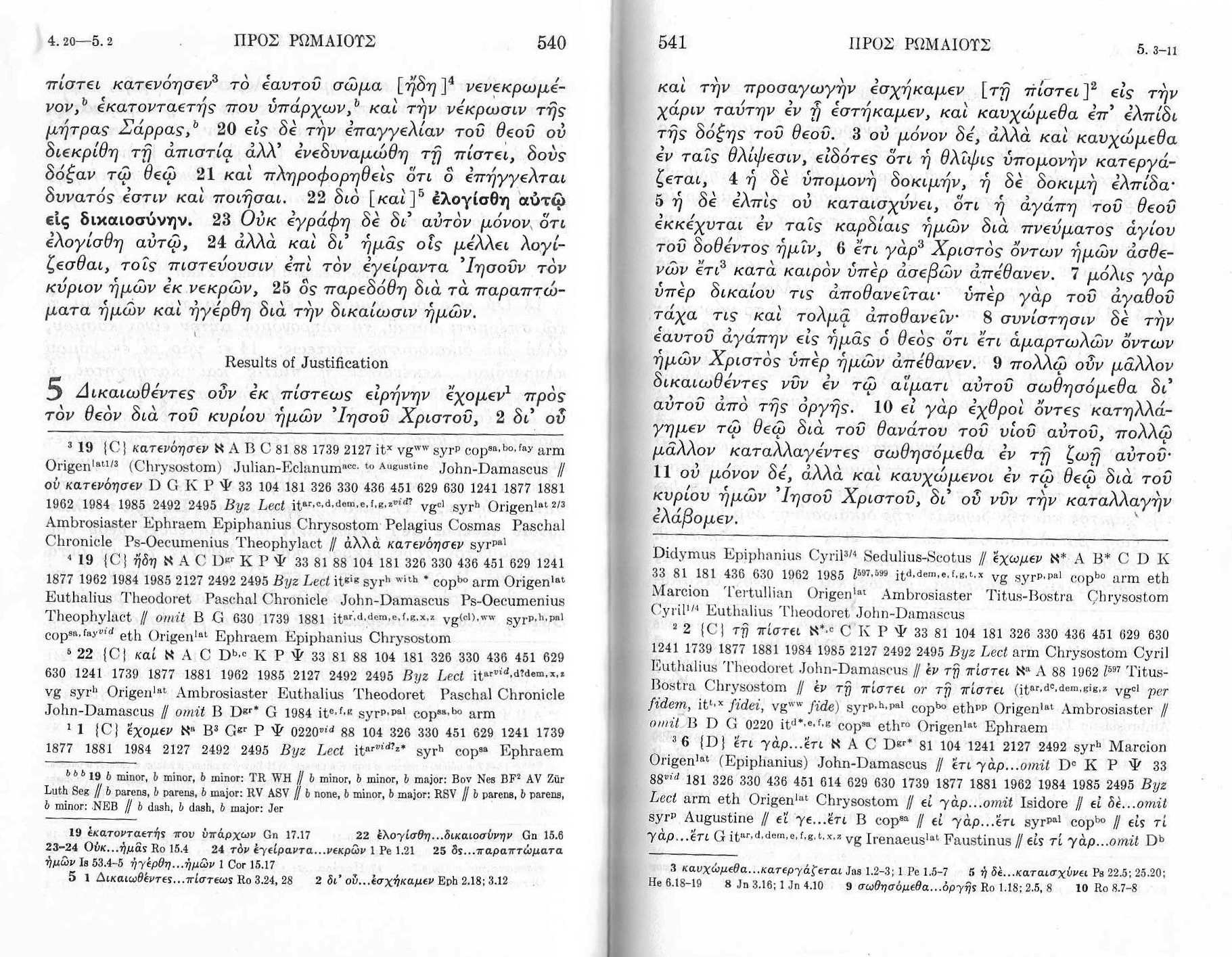
Romans 4:19b-5:11 in the standard critical edition used by Bible translators: The Greek New Testament, Third Edition (Münster, West Germany: United Bible Societies 1975), commonly known as USB3. This is a scan from the copy given to me as a student by the Canadian Bible Society in 1985, and there have been new editions – USB4 (1994), USB5 (2014), and USB6 (2025).
So what do the results of these five centuries of Biblical study say about today’s reading?
The first thing of significance is textual criticism of Romans 5:1. The critical edition pictured above is assembled from literally thousands of manuscripts and hundreds of papyrus fragments. Some of the manuscripts and fragments are considered more important than the rest because of their age and the apparent care they took in copying. There is a significant variation in the manuscripts for chapter 5 verse 1: is it ἔχομεν or ἔχωμεν? The only difference is the middle letter, omicron or omega. In the Koine Greek of the New Testament they would have sounded the same, as they do in a Modern Greek pronunciation. However, the meaning is a little different – the first means “we have” and the latter is “let us have.”
Interestingly, the textual apparatus gives ἔχομεν a “C” rating, meaning “that there is a considerable degree of doubt whether the text or the apparatus contains the superior reading” (USB3 xiii). In fact, the editors have done a rare fudge – the reading in the apparatus, ἔχωμεν (“let us have”), is far better attested, being in the original manuscripts of Sinaiticus, Vaticanus, Alexandrinus, Ephraem Rescriptus, and Bezae Cantabrigientus, various later Greek manuscripts, as well as a host of early translations and quotations in Church Fathers (including Tertullian, Origen, John Chrysostom, Cyril of Alexandria, and John of Damascus). Bruce Metzger, in A Textual Commentary on the Greek New Testament (London & New York: United Bible Societies, 1975; p. 511) observes that the manuscript evidence suggests ἔχωμεν over ἔχομεν, but states that “only the indicative is consonant with the apostle’s argument.” In other words, since they followed Luther’s interpretation of Romans, they chose a reading that went against the evidence.
This is where the second point comes in. Paul did not know that he was writing scripture. He thought he was writing a letter that would be read aloud and heard by believers in Roman house churches, not a theological tract that would be poured over and lectured upon by Martin Luther fourteen centuries later, or by us twenty centuries later. Paul clearly thought his letter was important, because it is so long, but why is it important? While it is important to us as a witness to Paul’s thought, for him it was because he was planning to come to Rome, and from there travel on to Spain, and he hoped that he would be welcomed.
That reason alone would not take up the over seven-thousand words of the letter. The length of the letter may be accounted for because Paul had heard of divisions in the various house churches in Rome. Some thought themselves better than others. This is an issue Paul discussed for several chapters in First Corinthians (2-4, 12-14); because he had participated in founding the church in Corinth, he did not hesitate to criticise the Corinthians for it. His audience in Rome was different – he did not found and did not know the churches in Rome (although he knew a surprising number of people there). Thus he was perhaps more careful, more theological, and more rhetorical in how he phrased his critique of divisions. Now, scholars argue about what the division exactly was – we do know that there were those who were “stronger” and those who were “weaker,” and he admonished the stronger. Some have seen this as a division between Jewish Christians and Gentile Christians, others as between Jews and Christians generally, and still others between Torah observant Gentile Christians and non-Torah observant Gentile Christians. Regardless, he challenges the pride and hubris of the “stronger” side, and called them to humility and unity.
So, if he was concerned that the house churches in Rome were disparaging each other and falling out of love, a more accurate translation of the first verses of Romans chapter 5 is likely to read,
Therefore, having been made righteous “by faith”, let us have peace with God through our Lord Jesus Christ, through whom we also have gained access in the faith to this grace in which we have stood; let us also boast in the hope of the glory of God; not only that, but let us also boast in our afflictions . . . because the love of God has been poured into our hearts through the Holy Spirit that was given to us. Romans 5:1-3a, 5b (Robert Jewett, Romans: A Commentary (Hermeneia Series) (Minneapolis MN: Fortress Press, 2007), p. 344.
Several key words leap out (and here I am drawing on Jewett’s commentary): προσαγωγὴν “access”, καυχᾶσαι “boast”, and ἀγάπη “love”.
προσαγωγὴν “access”: In the First Century Roman Empire “access” to one’s patron or that principle citizen, the Emperor, was an important thing. If you had access, or you knew one who did, then they were important and could get things done, telling others what to do. Paul here seems to be using “access” here in a subversive way, referring it to God. Our Lord Jesus Christ is someone who can get it for us, and by whom we get the grace of forgiveness.
καυχᾶσαι “boast”: Romans boasted of many things – their power, their wealth, their divine favour, the size of their Empire, the comparative weakness of their enemies, their dignity. Paul subverts this by encouraging the members of the Roman House Churches to boast only of their afflictions, their sufferings for Christ.
ἀγάπη “love”: The love which Paul describes is, properly, divine love. It is the love which he knows in Jesus and in the community of the church, the body of Christ. Again, this is not just a loving relationship between God and the forgiven sinner, but between all believers and with God. The Romans would not be sympathetic to this kind of love, as it is the kind of thing that gets in the way of earning wealth, reputation, and power. Paul best described this love in First Corinthians chapter 13:
If I speak in the tongues of humans and of angels but do not have love, I am a noisy gong or a clanging cymbal. And if I have prophetic powers and understand all mysteries and all knowledge and if I have all faith so as to remove mountains but do not have love, I am nothing. If I give away all my possessions and if I hand over my body so that I may boast but do not have love, I gain nothing.
Love is patient; love is kind; love is not envious or boastful or arrogant or rude. It does not insist on its own way; it is not irritable; it keeps no record of wrongs;it does not rejoice in wrongdoing but rejoices in the truth. It bears all things, believes all things, hopes all things, endures all things.
Love never ends. . . And now faith, hope, and love remain, these three, and the greatest of these is love.
The way Paul speaks here can be difficult to follow, but to my mind, if we understand that the apostle is calling the Christians in Rome to unity, the choice of his words make more sense than if he was dictating some kind of First Century, 7000 word Summa Theologica.
A Tension
The readings we used today are not supposed to be about the same thing, and, indeed, they are not. The way the lectionary is constructed, now that we are in “Ordinary Time” (that is, counting Sundays after Trinity in Year A of the three-year cycle), is that the Gospel reading is from Matthew and the other New Testament reading is from Romans. The readings are continuous, picking up where last week’s reading ended. Any thematic relationship is accidental. However, a preacher is liable to see connections, since, in theory, all scripture is interrelated. There may be similar themes, or there may be obvious or implied tensions.
Today I see a tension between Romans and Matthew. Today’s gospel reading is from the so-called Missionary discourse, one of five extended speeches by Jesus in the Gospel according to Matthew which seem to parallel the Five Books of Moses in the Torah; the first discourse is the Sermon on the Mount, the Missionary Discourse is the second, another is parables, and the last is about Last Things. In the Gospel according to Matthew Jesus is portrayed as the one who fulfills the Torah:
Do not think that I have come to abolish the Law or the Prophets; I have come not to abolish but to fulfill.For truly I tell you, until heaven and earth pass away, not one letter,not one stroke of a letter, will pass from the law until all is accomplished. Therefore, whoever breaks one of the least of these commandments and teaches others to do the same will be called least in the kingdom of heaven, but whoever does them and teaches them will be called great in the kingdom of heaven. For I tell you, unless your righteousness exceeds that of the scribes and Pharisees, you will never enter the kingdom of heaven. Matthew 5:17-20
Indeed, he not only does not do away with it, but calls his followers to a higher righteousness; this is very apparent in 5:21-48. Jesus does not sound like someone who is exhorting his disciples just so they can fail, as Luther’s construction of sin and grace, Law and Gospel would have it; rather, Jesus expects his followers to “be perfect, therefore, as your heavenly Father is perfect” (5:48). Jesus is a new, more demanding Moses here, to whom all authority has been given, and calls his disciples to, “Go therefore and make disciples of all nations, baptizing them in the name of the Father and of the Son and of the Holy Spirit and teaching them to obey everything that I have commanded you.” There is nothing here about the binaries of Luther.
The first half of today’s reading is judged by most scholars to go all the way back to Jesus. His instructions to the Twelve reflect a very early stage of mission work, as it is only to the Jews and not to Samaritans and Gentiles. It is a straight-forward economy of mission – the disciples preach the good news, “‘The kingdom of heaven has come near.’ They cure the sick, raise the dead, cleanse the lepers, and cast out demons. In return, they are fed and housed by those who welcome them. There is no sense that they are establishing any permanent institutions, such as an assembly or church.
What is striking is that the Mission of the Twelve is not what Paul is doing in Romans. Jesus does not tell the disciples to preach about justification by faith alone, but to proclaim the proximity of the Kingdom of God. Like Paul, it is a subversive message, undercutting the Imperial Rule of Rome and the Emperor. It is a proclamation that is demonstrated in acts of power – the lepers are healed, the dead are raised (!), and demonic powers driven out. All of these are signs of the kingdom, where death and disease are defeated. It feels as if we are in a different world from Martin Luther’s interpretation of Paul, in that the emphasis in Matthew is more on a Christus Victor type of narrative, where Jesus and his disciples are combating the powers and principalities of the tempter. There is no mention of faith or justification, just the good news, implying the coming condemnation of eveil.
To me this suggests that what we have in the New Testament and the whole of the Bible is not one theology that can be summed up in the way that Luther thinks, but a polyphony of various themes and approaches. God calls us to mission and by the Holy Spirit empowers us. It may take the form of evangelical conversion, in which one is convicted of sin, repents and confesses Christ, and is thereby saved, but it may also be a faith who’s origin is not remembered but has been nourished in the sacraments and the life of the assembly of God, and where one’s sinfulness is mild in comparison to what is condemned in scripture.
Invitation
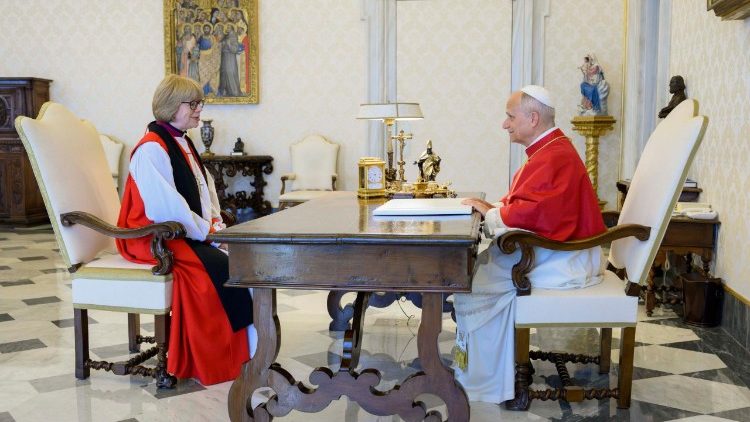
The Archbishop of Canterbury, the The Most Reverend and Right Honourable Dame Sarah Mullally, meets with His Holiness Pope Leo XIV, 27 April 2026, at the Vatican.
Our salvation comes to us by grace alone, and while this is signified by the faith given to us, this faith can be seen as a dynamic, evolving thing. It can be a faith that acknowledges ambiguity and grey areas, while still certain that in Christ we have found the Truth. It is rooted more in a relationship with God in Christ and less in the intellectual assent to propositions.
It is a faith that calls us to unity. In the past century we have made great strides as Anglicans, Catholics, Orthodox, Lutherans, and Calvinists in understanding and appreciating each other. As the church in Rome had its issues already in the First Century, so we continue with divisions twenty centuries later. May we continue in dialogue, exhortation, forgiveness, and mission so that glory may be given to God.
This has been one of the harder posts to write because I’ve never really seen myself as an expert on analytic philosophy. It is probably because I am not overly sympathetic to it – while it strongly influenced the course of studies I did at the University of Toronto in my first degree, my subsequent studies led me to Continental philosophy and a critique of the methods and issues of analytic philosophy. Well, let’s have a go, eh?
As far as I can tell, Levinas never read Wittgenstein and Wittgenstein never read Levinas, an example of the two silos of analytic and continental philosophy. Despite their lifespans overlapping and both being part of intellectual European society, they were in two very different philosophical camps. I should say something about these two philosophical approaches, as the difference between the them is undoubtedly the most important distinction between them. I will start with Wittgenstein and the Analytic tradition.
Wittgenstein is considered to be in the Anglo-American Analytical tradition, whereas Levinas is firmly in Continental phenomenology. Both traditions are well over a hundred years old, and while each has been obliged to defined itself against the other, it seems to me that Analytic philosophy spent far more time disparaging phenomenology than vice-versa. In this second decade of the Twenty-First Century we are very much in the post-analytical and post-continental phase, where philosophers from each camp are reading each other a little more generously than fifty years ago, although they can still be dismissive of each other. Now, as one might expect with anything that has gone on for over a century and has many participants, both traditions defy simple definitions. However, relying on my education some forty-five years ago, allow me to draw out some characteristics of each, beginning with Analytic philosophy.
There are two things one can point to in the history of analytic philosophy in its first fifty years.
The first is a that starting around 1900 there was reaction to the Idealism that was popular in 19th century Britain. Derived from Hegel, the Idealists challenged the Kantian irradicable separation between our knowledge of a thing, and the “thing in itself.” Kant believed that, as human beings, we have sensations and perceptions that are processed by our minds. A mind imposes itself on our perceptions so much that that, while we sense we are in the world, we can only know the world in the categories that our sense-perceptions and our brains use to interpret it. British philosophers such as Josiah Royce and F. H. Bradley attempted to bridge that gap by arguing for a reality they called “the Absolute”, a self-sufficient reality in which thought and being are one. This led to reflections on being and the categories of thought.
The first British analytic philosophers were influenced by Gottlob Frege (1848-1925), a German mathematician and philosopher who developed symbolic logic and sought to determine their relationship. Bertrand Russell (1872-1970) published The Principles of Mathematics and continued that work with Alfred North Whitehead (1867-1941) in the three volumes of Principia Mathematica (1910-1913). In these dense, difficult books Russell and Whitehead sought to prove that logic and mathematics were the same, to develop a system of symbols to do symbolic logic, and to analyse several logical puzzles.
In terms of epistemology, the early analytic philosophers rejected the Idealist notion of “the Absolute” in which things are known in the context of a whole. Instead, they focused on propositions and their relation to facts, and whether propositions could be reduced to a logical form and evaluated on the truth value of the various elements.
If matters could not be reduced to some form of logic, or if the propositions could not be verified or falsified, then the propositions stating them were nonsensical. They were not without meaning, but the meaning was untethered in the real world. Thus, metaphysics, theology, and ethics were all considered to not be in the field of philosophy, and most analytic philosophers went further and believed that metaphysics and theology, in particular, was nonsense. G. E. Moore, in his Principia Ethica (1903,) analyses the concept of “the good” and concludes that it has no single definition, and that what the good is in any particular situation depends on the context; in the end he appeals to common sense and human intuitions, rather than settling on a definition, rule, or essence. Ethics, then, is removed from the realm of logical philosophy, as is politics.
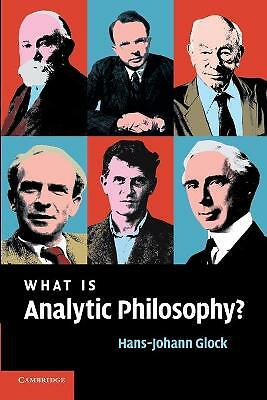
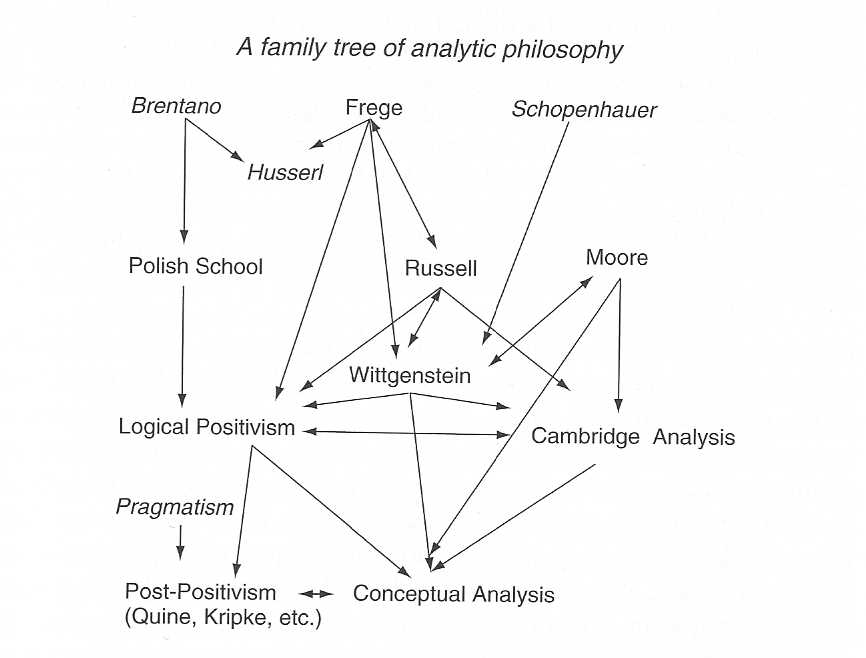
From Hans-Johann Glock, What is Analytic Philosophy? (Cambridge UK: Cambridge University Press, 2008), p. 227.
As you can see in the above diagram, Wittgenstein is in the middle. Following his studies with Russell and Moore at Cambridge he began writing the Tractatus Logico-Philosophicus in Norway in 1913, developing it in the German trenches and camps during the Great War, and publishing it in German shortly thereafter. In it he believed that he had solved the major problems of philosophy, and went on to do what he considered to be more important work, namely, teaching children in rural Austria. The Tractatus was translated into English and published at the behest of Russell, who considered it vitally important. The work was almost entirely concerned with propositions and their relation to the world of facts. Wittgenstein admitted the importance of ethics and morality, art and religion, but held that these were not matters that concerned philosophy; in the famous last line of the Tractatus, “About things we cannot speak of we must keep silent.”
In the 1920s and 1930s the group of philosophers known as Logical Positivists went further than Wittgenstein or Russell in holding that if something cannot be made in a verifiable statement, then it truly is meaningless. It was a profoundly empirical approach to things, rooted in the primacy of the scientific method, and they took the sparse logical approach of the Tractatus as a basic text. One portion of the Logical Positivists were based in Vienna, known as the Vienna Circle, and on a number of occasions Wittgenstein met with some of its members individually. Wittgenstein came to believe that he was misunderstood, and so, by the late 1929 he returned to Cambridge to do more research. Unusually, the university treated his now decade old Tractatus as a PhD dissertation, and Russell and Moore did a pro forma oral examination; this enabled him to teach, and by 1939 he succeeded Moore as the Professor of Philosophy.
Wittgenstein’s arrival in Cambridge signified the second moment in analytical philosophy, namely, the linguistic turn. Analytic philosophy became very much the philosophy of language.
Concluding that human language was not reducible to logical propositions, he struggled towards understanding the function of language and the way meaning worked in it. While typed out manuscripts circulated among his colleagues and students, his results were only published two years after his death in 1951 as Philosophical Investigations (1953). The key thing about any proposition or statement is that it is embodied in a human context, a form of life. The habit of prior philosophy is to abstract it out of that context, to remove it from its time and place, as if that its abstraction is somehow more true and real. Wittgenstein famously stated that the meaning of a word is its use – something seemingly obvious, but so often ignored, whether by language mavens with prescriptive definitions or by philosophers who would ascribe a type of being – essence – behind words. He described language as a kind of game, with rules like football, whereby something has meaning within those rules, but may not when taken out of the game. We know what a goal is in ice hockey, but what is its meaning in tennis?
This linguistic turn evolved into the analysis of linguistic puzzles, demonstrating that people often ask words or language to do things that they are not equipped to do. Conceptual analysis, which followed on from Wittgenstein, sought to take concepts apart and show what they could and could not do. In 1955 the analytic philosopher J.L. Austin developed the notion of speech acts, which examines the roles that vocal utterances play in human communication.
In the next post I will discuss Continental philosophy. After that, I will finally get to Levinas and Wittgenstein on language.
This morning, as advertised, I want to talk a little bit about faith, especially as used in the Letters of Paul. In Romans 4:16 we heard that “For this reason the promise [to Abraham] depends on faith.” Now what is the nature of this faith?
Paul dictates a letter while in prison. I have no idea what he is doing with his hands.
In 1983 an American New Testament doctoral student named Richard Hays at Emory University, Atlanta, had his PhD dissertation published. It was entitled The Faith of Christ: The Narrative Substructure of Galatians 3:1-4:11 (my version is the 2nd Edition, Grand Rapids MI: Wm. B. Eerdmans Publishing Co., 2002).This was the equivalent of a bomb being set off among Pauline scholars, as the issue was what Paul meant by πίστις Χριστού. Those of you who know some Greek know that πίστις is the word we normally translate as “faith” and Χριστού is the Greek genitive of Χρίστος, which we transliterate as “Christ”, and corresponds to the Hebrew מָשִׁיחַ, (māšīaḥ), meaning the anointed one, such as a king or Zadokite priest.
A genitive means that it is a most often a possesive, although it varies across languages. Thus, one must distinguish between a genitive grammatical form and the grammatical function. In English a genitive is marked by the addition of “‘s” to a noun or name, eg. This is Frances’s dog. In Standard Modern Greek, that’s Αυτός είναι ο σκύλος της Φράνσις. The real question is how we are to understand the relation of these two words πίστις and Χριστού – its function. Traditionally, Χριστού has been understood as an “objective genitive” which is to say that it is faith IN Christ. We are the subjects, and we have faith in the “object” of Christ. Hays in his 1983 dissertation made a strong argument, based on narrative logic, that in fact πίστις Χριστού should be understood primarily, in Galatians 3:1-4:11, at least, as a “subjective genitive” – that is, that it is the faith OF Jesus – his faithfulness, his obedience, his trustworthiness. Thus, to say that we are saved by πίστις Χριστού means not that we are saved by our faith in Jesus, but that Jesus’s faithfulness saves us.
Martin Luther making a post to his blog old-style, by nailing the 95 Theses to the door of the church at Wittenburg, October 31, 1517.
You might be able to imagine why this was so controversial. Back in 1517 Martin Luther nailed his ninety-five theses to the church door in Wittenberg, Germany, thereby inadvertently but very unapologetically setting off the Reformation and the transformation of Europe. Central to his message was the idea that we are saved not by doing good works, like buying indulgences and helping to pay for that new basilica of St Peter’s in Rome, but by faith in Jesus. Luther saw that faith leaping out of Paul’s Letters, especially Romans and Galatians. Right conduct was important, but it followed from that faith, and ultimately it was God’s grace given through Jesus Christ that saved a person for eternal life.
Evangelical Christianity felt it was incredibly important that people have this faith – not some weak connection to church, or a mere membership in the denomination by virtue of baptism, but a lively faith that could express itself. Yes, a person with faith did also sin from time to time, but hoped and trusted that, with frequent repentance and confession one would still stand in the grace of God.
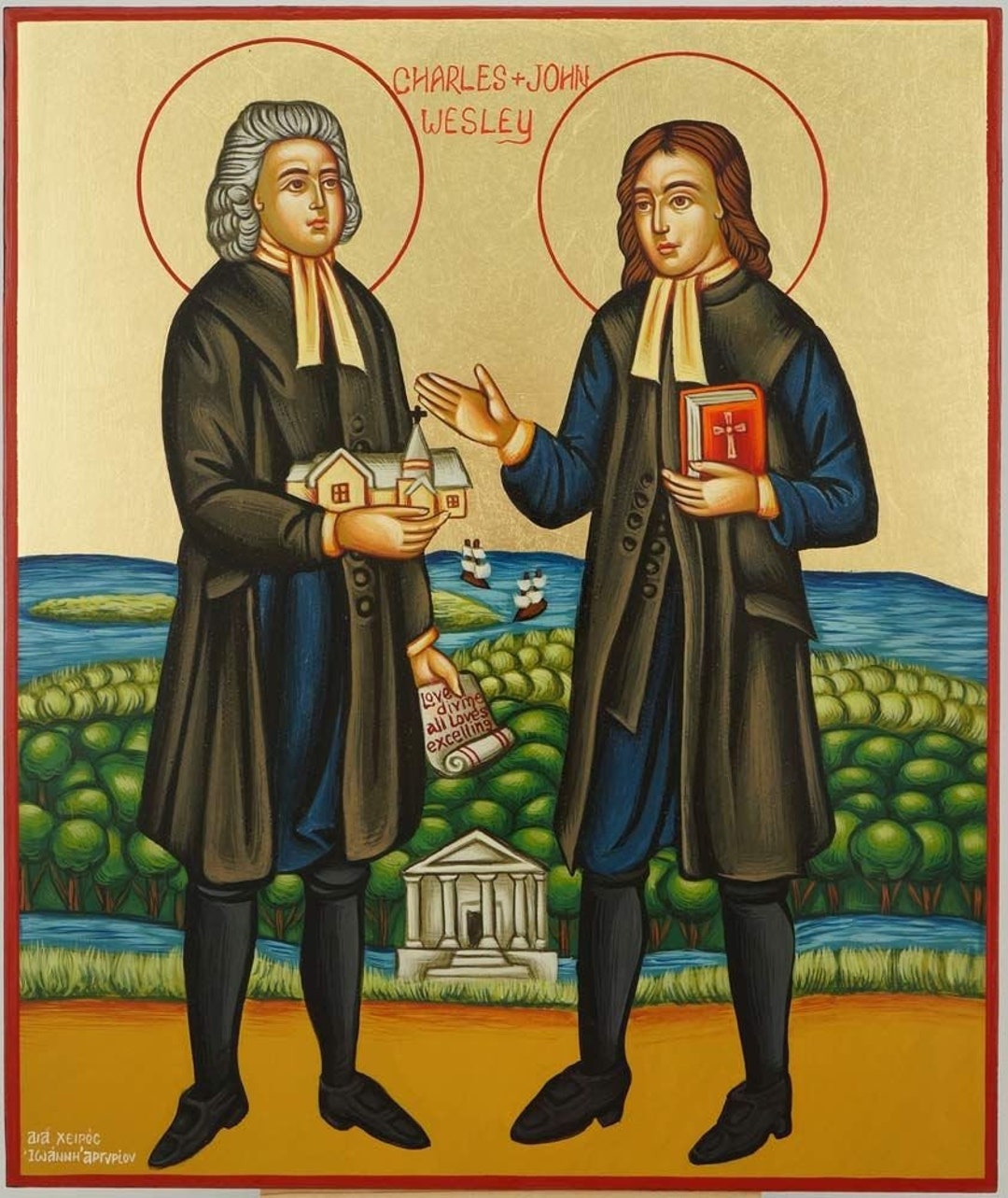
John and Charles Wesley
In the English speaking world evangelicalism might be said to be started in the 18th century by the brothers John and Charles Wesley, two Church of England clergy. Each experienced a dramatic warming of the heart – a conversion or a renewal of faith. Later called “Methodists” because of there methodical way of studying scripture and praying in groups, they laid great emphasis on a person’s individual commitment to Christ, and the emotional and affective knowledge of this. This “enthusiasm” for faith alarmed many church leaders, and they were made unwelcome in many Church of England parishes. The brothers began to preach in the fields to hundreds and thousands, and wrote hundreds of hymns for their followers. While some of this form of evangelicalism stayed within the low church parts of the Church of England, after their deaths the “Methodists” organised themselves into a new Protestant denomination.
For some, the emphasis upon belief meant that the sacrament of baptism needed to be reserved for those who could profess belief in Jesus Christ. Thus, Baptists broke away from the churches that baptised infants and young children, and required a testimony by a candidate for baptism before being initiated.
All of this is very much in contrast to a High Church Anglican, Roman Catholic, or Eastern Orthodox understanding, which is that by baptism and the eucharist one is incorporated into the Body of Christ. In this thinking some of us may be saints, some great sinners, and most of us are in-between, but all are saved by the grace of God because of God’s actions in Christ Jesus. Thus, what Jesus did in his teaching, death, and resurrection, is far more important than the content or quality of faith of any single believer. We are all works in progress, in this way of thinking.
Well, the controversy rages on, as much as you can call scholarly articles going back and forth raging. I have here a recent contribution coming from Nijay Gupta, an American who got his PhD at Durham, Paul and the Language of Faith (Grand Rapids MI: Wm. B. Eerdmans Publishing Co., 2020). Gupta notes a variety of ways to translate πίστις that go beyond the two alternatives considered by Hays.
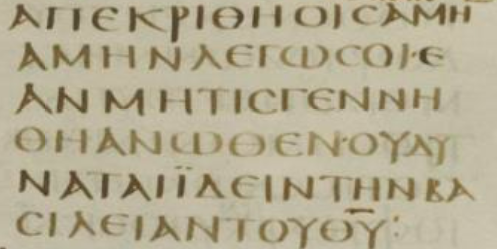
John 3.3 from Codex Sinaiticus, a Biblical manuscript from the mid-Fourth century. No punctuation! All capital letters!
Let me pause here and make a connection with the gospel reading. Chapter 3, verse 3: Ἀμὴν ἀμὴν λέγω σοι, ἐὰν μή τις γεννηθῇ ἄνωθεν, οὐ δύναται ἰδεῖν τὴν βασιλείαν τοῦ θεοῦ. Amen, Amen, I tell you, no one can see the kingdom of God without being born from . . . – how does that phrase end? Most people would say “born again”. However, our translation says, “born from above”, with a footnote admitting the alternative translation. People argue about the best way to translate that Greek word ἄνωθεν – “again” or “from above” – but my friend and colleague Andrew McGowan who teaches at Yale University suggests that the ambiguity in the Greek should be kept. It is both.
Maybe that ambiguity is there also in Paul. When Paul uses the phrase πίστις Χριστού perhaps he means both the faith or a kind of trust in Jesus, and at the same time mean the faith of Christ, the faithfulness of Jesus and his obedience even unto death, even death on a cross. This is a faith that dwells in us by the power of the Holy Spirit. In the end it is all the grace of God. I experience the faith of Christ in me as my faith in Christ, and a kind of unearned faith of God in me, despite all the evidence of my fragility and sinful nature. Perhaps Evangelicals, Catholics, and Orthodox all have part of the truth of the matter.
The good news is that whether subjective or objective, we have faith. This faith is not something that is static, but is dynamic and growing, faith seeking understanding (as St Augustine would put it). This morning I have suggested that it is both ours and put in us by God. May we continue to grow in the faith of Christ, into the full stature of Christ. May we grow as a church, in numbers, in spirit, in our impact on the community around us. May the faith of Christ that is in us justify us and make us righteous.
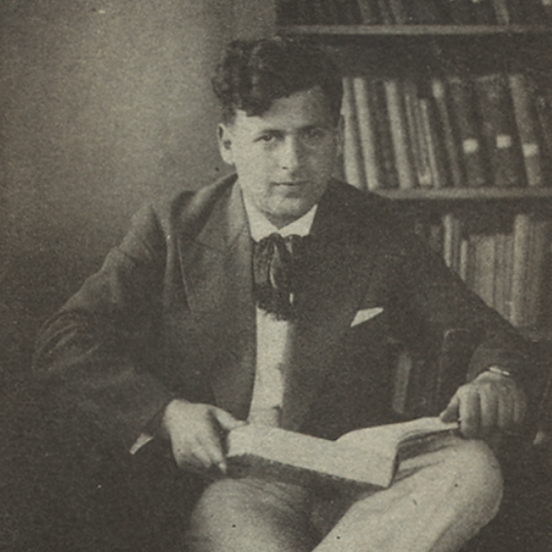
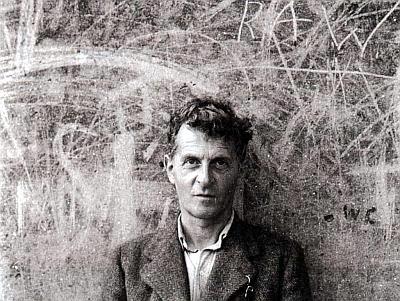
This is a remarkably poorly named blog post, as I will not actually be discussing Wittgenstein and Levinas and their approaches to language until the post after the next one. My previous post was perhaps even more poorly named, as I barely mentioned the two philosophers, and instead talked about the courses I took at the University of Toronto. Well, at least in this one I eventually get around to talking about what the gentlemen have in common. In Part Two Section B (the next post) I will talk about their differences, especially the philosophical traditions from which they came and helped to form. Sections A and B of this Part Two will frame the post after the next one.
But first, more about me. Let me summarise what I think I learned from my career in philosophy.
An Education of Limitations
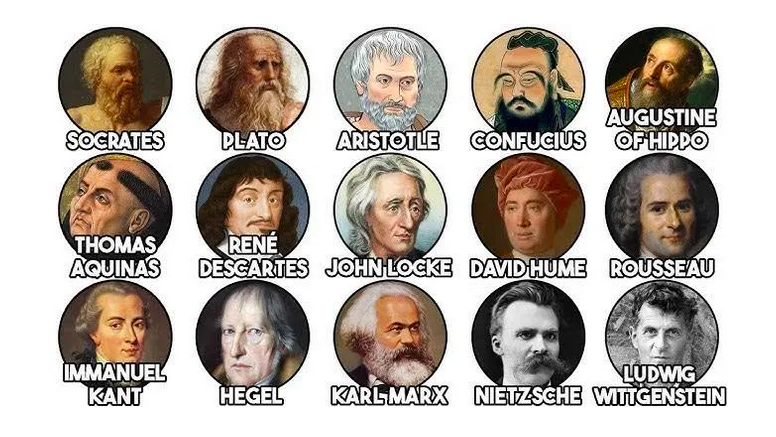
Some famous Dead White Guys (except for Confucius, who is a famous Dead Chinese Sage).
As one looks at the history of western philosophy from ancient Greece to modern times, a shift in the basic questions emerges. In the Pre-Socratics the dominant question was, “What is the world made of?” various answers came back, such as water, atoms, or observations about the ever-changing nature of the cosmos. The interesting thing is that the inquiries did not look to the gods of the Olympian pantheon, but to reasoning about things based on experience. In a sense, this was a proto-scientific method, although the Greeks did not advance to understanding how to do experiments.
With Socrates things shifted, as he asked, “What do we know?” Most of the time the answer came back that we know less than we think. Notoriously, Socrates challenged others who thought they knew what a concept or word was, and often left them confessing that they were wrong and that the natter was much more complex than they first admitted. His student, Plato, began to believe that we do know things in this world, but that they were shadowy impressions of ideals, such as Justice, the Good, Love, numbers, and so forth. Aristotle – Plato’s student – broke with his teacher and believed that while one could abstract the essence of a thing from our material world, there was no more-real world of forms or ideals. Aristotle (or his note-taking students) also wrote voluminously about everything, from biology to physics and theology (which, being the book that came after “Physics” in the manuscripts, was called “Metaphysics” or “after-Physics”). The key thing about Plato and Aristotle is that they gave a kind of reality to essences and causes, a way of thinking about things that dominated the next 2500 years. What is the meaning of a word? It will be found in its essence. Despite the plethora of philosophical ideas that followed, it can be argued that western society was dominated by a concern with metaphysics and how that leads to ethics and the good life.
Descartes shifted things dramatically with his Meditations. After him the issue became one of epistemology – how do we know things? Do we know things by reason alone, or can we know things by sensations. His use of doubt and intuition raised the value of certainty in philosophy to new heights. The Empiricists, the Rationalists, Kant, and Hegel all viewed epistemology as the foundational philosophy. This has come down to us as a series of puzzles – how do I know that another person has a mind like mine? What is the relationship between the words and ideas in my mind and the material world around me? What kinds of propositions are true, and what are nonsensical (or unproveable)? What is the relationship between my mind and my body? Are things like art and ethics utterly subjective, or is there some sense in which we can distinguish values within them? Is there any meaning to human life, or it is utterly absurd?
By the time I finished my degree in 1984 I was not particularly taken with the direction of modern philosophy in the Anglosphere. Frankly, it seemed quite depressing and uninspiring. It helped me think things through, and I became unknowingly adept at the old Jesuit maxim, “Never deny, rarely affirm, and always distinguish.” At least I learned how to write an essay, as I started getting some good grades in the last two years. However, I was drawn more to religion and the life of the Spirit, and found myself in the community of the followers of Jesus. But more about that later. On to Ludwig and Emmanuel.
Parallels
There are good online biographies on both philosophers, such as here in Wikipedia and also at the online Stanford Encyclopedia of Philosophy (“SEP”) for Wittgenstein, and here in Wikipedia for Levinas and here in SEP for him. Rather than repeat what is written there and in the many books about the two, I will simply highlight some things.
There are some interesting parallels between them.
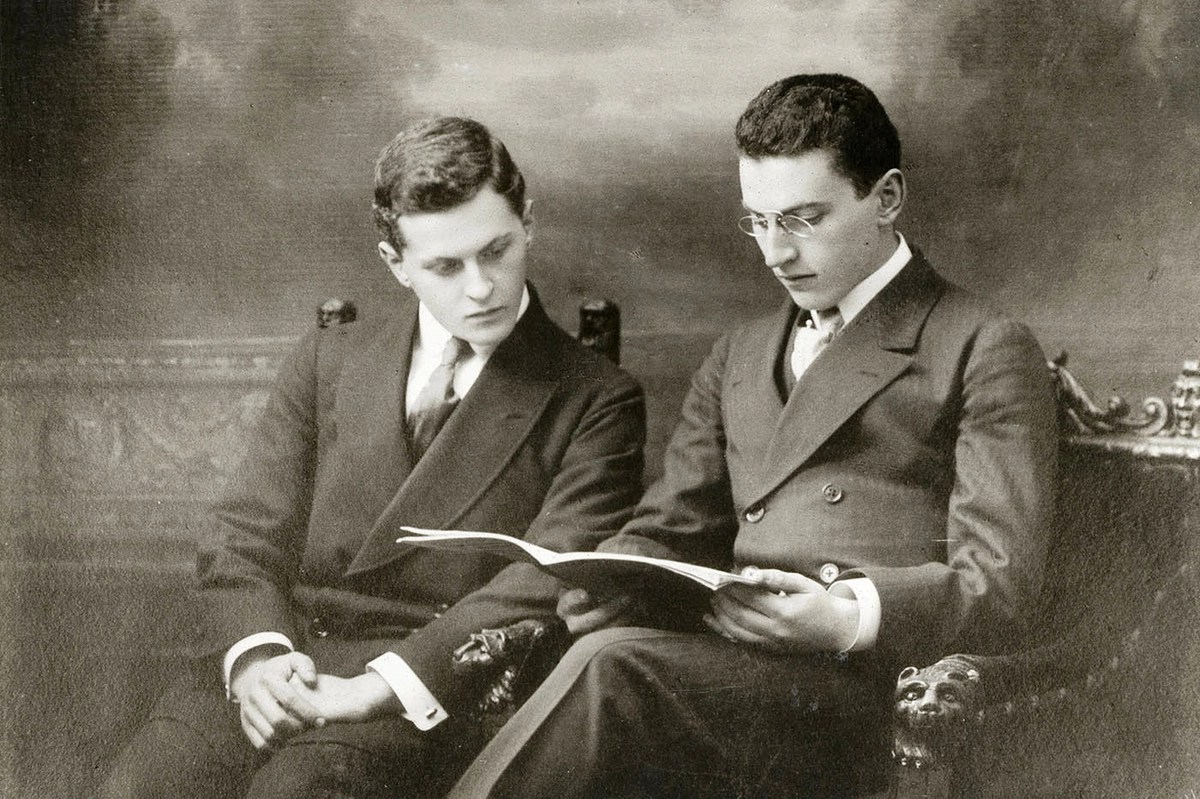
Ludwig and Paul Wittgenstein studying, photo by Carl Pietzner, 1909, via Österreichische Nationalbibliothek
Both were born in empires that ceased to be after World War One. Wittgenstein was born in Vienna in 1889, which was then the capital of the Austo-Hungarian Empire. After the Great War the Austro-Hungarian Empire broke up into Austria, Hungary, Yugoslavia, Czechoslovakia, and parts of it became Poland, Italy, and Romania. By default, as a man from Vienna, he became part of the new republic of Austria. Likewise, Levinas was born in the Russian Empire, in Lithuania, and his family found refuge from the fighting of World War One in Karkhiv, in Ukraine. After the war ended they returned to the new Republic of Lithuania.
Both studied outside their home countries. Wittgenstein first studied mechanical engineering at the Technical University of Berlin (1906-1908), and then did graduate work in aeronautics at the Victoria University of Manchester (19908-1911), and finally at the University of Cambridge to work with Bertrand Russell on the philosophy of mathematics and logic (1911-1913). Levinas went to Strasbourg in the recently recovered French province of Alsace-Lorraine (1923-1930), to study philosophy, and spent one eventful year(1928-1929) at the University of Freiburg-in-Breisgau, where he said, “I went for Husserl, but found Heidegger.”
Both functioned in languages other than their native ones. While Wittgenstein wrote his major works in German, he lectured and taught at Cambridge in English. Levinas was even more of a linguist, growing up speaking Russian, but learning Lithuanian, German, Aramaic, Hebrew, and French. His major essays and books were all in French.
A young Emmanuel Levinas in Kaunas, Lithuania
Both were immigrants and became citizens of their new home countries in 1939, Wittgenstein of the United Kingdom, and Levinas of France.
Both served in the military and spent time in Prisoner of war camps, Wittgenstein in the First World War with the Austrian army, and Levinas in the Second World War with the French army. Wittgenstein was captured at the beginning of November 1918 on the Italian front, and spent nine months as a prisoner. Levinas spent most of the Second World War war, from 1940 to 1945, in a German camp for French Jewish military, where he spent most of his time chopping wood. Wittgenstein was too old to fight in the Second World War, and by then he was in the United Kingdom. He served in a couple of civilian roles in hospitals.
Both were ethnically Jewish. Three of Wittgenstein’s grandparents were of the Jewish faith, although by Ludwig’s time they had been Roman Catholic Christians for three generations. Levinas was raised in a semi-assimilated Jewish household, speaking Russian at home but attending synagogue and finishing his secondary education at a designated school for Jews. His primary reason for studying in France was the Dreyfus Affair, thinking that it was worth living in any country that could do such self-criticism around the persecution of a Jew.
Both contrasted Greek philosophy with Hebraic thinking, seeing the former as eschewing transcendence and the latter as embracing spirituality as a way of life.
Both had professional pianists in the family. Levinas’s son is Michaël Levinas (b. 1949), who is both a concert musician and a composer. Paul Wittgenstein (1887-1961), Ludwig’s older brother – the one who did not commit suicide – is perhaps best known for having commissioned piano works for one hand, after losing his right arm in the Great War; perhaps the best known is Ravel’s Piano Concerto for the Left Hand (1930).
Both were school teachers. After the Great War Wittgenstein taught elementary school children, from 1920 to 1926. After receiving his doctorate, Levinas taught at a Jewish High School in Paris, l’École normale Israélite orientale, eventually becoming the principal; this school also functioned as a Normal School, training Jewish French teachers to go and work across North Africa and the eastern Mediterranean.
Both read the Russian classics of Tolstoy and Dostoevsky, and each was influenced by them, albeit in different ways.
Both are best known for two major works. Wittgenstein published little, but in his lifetime he was best known for the Tractatus Logico-Philosophicus (1921) and after his death his students edited Philosophical Investigations (1953). Levinas published voluminously, but he is best known for Totality and Infinity: An Essay on Exteriority in 1961 and in 1972 Otherwise than Being or Beyond Essence. It is often claimed that Wittgenstein developed a completely different philosophy to his Tractatus, but his later philosophical work can be understood better as a reframing of what he tried to do in the Tractatus, which so many readers seemed to misunderstand. Likewise, Otherwise than Being restates the basic themes of the earlier book, but does so in a way to respond to the critique of Jacques Derrida in his long essay on Levinas Metaphysics and Violence.
Most of the time when we watch a movie or a television show, or read a book or short story, we do not know how the story ends. This creates a kind of tension – what is going to happen? Will the hero prevail? Will the evildoers be punished? Will I be surprised by the twist ending? Who did the murder? Was it the butler? Or the vicar? Will Godot show up to see Estragon and Vladimir? Will Michael Corleone continue to turn away from his father Vito? What will the astronauts discover when they go to Jupiter in 2001: A Space Odyssey? Will Luke Skywalker give in to the Dark Side?
Obviously there are exceptions. People who read romance novels or watch Hallmark Christmas movies know that the couple will get together. People who watch formulaic horror movies know that the teenagers will get murdered, except for one who will wreak vengeance on the horrific villain. These kinds of books and stories are not <ahem> critically acclaimed, even if beloved by their fans. Most modern literature is not formulaic, or if it is in a genre, it plays with the norms to do something new and different.
This tension around the unknown in drama and literature is quite modern, and has not always been the case. In ancient Greek tragedy the audience always knew that it was going to end in tears, with Agamemnon dead, Oedipus blind, and Medea having murdered her children. The point in attending the drama was to see how the story was told – did the chorus dance and sing well, and did the three main actors convey the commissioned author’s words? Likewise, with the Homeric Epics everyone knew that Achilles would return to battle to avenge Patroclus, and that Odysseus would find his way home. The enjoyment was in the performance and the skill of the performer retelling the familiar episodes. In that respect it was a bit like modern day patrons of opera going off to see a performance of a work written a century ago – they know the score already and can probably hum the arias; they’re there to hear the divas and male soloists, and to take the measure of the music director, the orchestra and chorus, and the design.
The early Christians likewise, after accepting the gospel, knew the outline of the narrative. The Christian story is very simple. It is good news. Despite the evil in the world, good prevails. God wins in Jesus Christ. The victory is already predetermined, and while evil may persist much longer than we care, ultimately it will be overthrown.
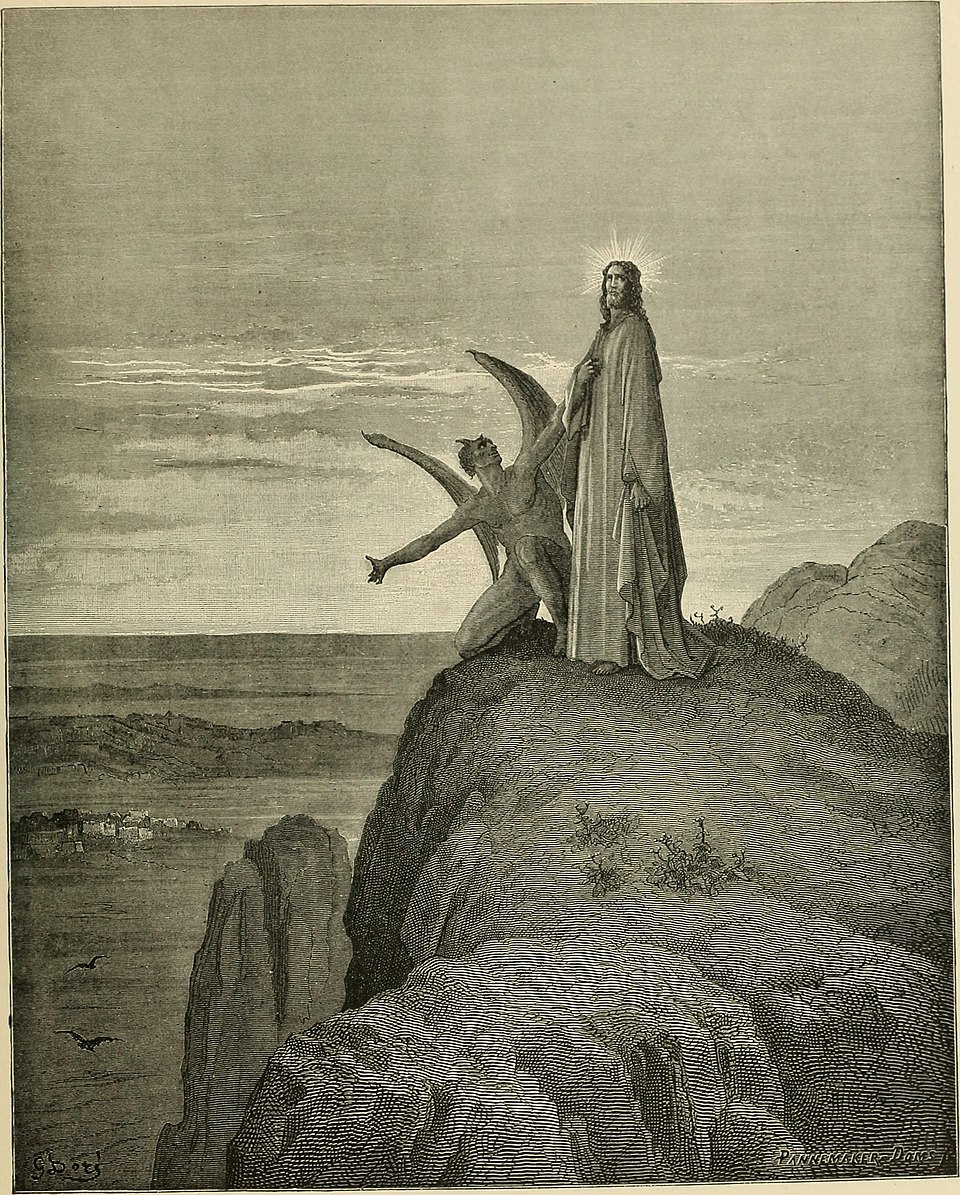
This is true in our gospel reading, in which Matthew tells of the three-fold temptation of Jesus. There really is no tension. I do not think that the first hearers of the Temptation of Christ were at all worried that Jesus might give in to Satan, that old snake, the tempter. It was how he overcame the temptation that was more important, and what it points to. The early Christians already knew that evil had been defeated in the death and resurrection of Christ.
As modern day Christians we are interested in the psychological state of Jesus in the wilderness. He is described as famished, and is undoubtedly physically weak (forty weeks without food is at the extreme end of what is humanly possible). The tempter tries to tempt Jesus. Is Jesus at all slightly persuaded? What was the internal thought process? This is exactly what Nikos Kazantzakis explored in his 1955 novel The Last Temptation of Christ, where Jesus wrestles with his divine nature, and is tempted in a dream to live an ordinary life without sacrifice and death on the cross. But Kazantzakis is a modern author, and the book speculate about the inner life of Jesus that the gospels barely attend to. So, while we might wonder what Jesus thought in his physically vulnerable state, that was not a concern to Matthew or the other evangelists.
The tempter tempts Jesus three times. First, he encourages him to show himself by turning stones into food – a demonstration of power. Then he suggests that he jump off a tall building, to see if the angels will save him – a demonstration of biblical fulfillment. Then, as if they belonged to him, he offers Jesus the kingdoms of the world.
Now, Satan here thinks he’s clever. He even quotes scripture to the Son of God, as if proof-texting necessarily leads to persuasion. But he’s really not that bright – his pride and arrogance overcomes what he should know. He thinks he might be able to persuade Jesus to turn against God the Father and instead show off his powers, test the promises of scripture about angels protecting the Messiah, and worship him instead. But he should know better, right? After all, he may be a fallen, but he is an angel, and so should have some insight into how the divine works. But he is wrong in his hopes, and fails miserably. He leaves to challenge Jesus again at the cross, through the Roman rulers of Judea and their collaborationist leaders of the Temple.
You see, this is where evil is so often very stupid. Evil can be crafty and clever, and it can marshal great resources and seduce good people, but so often the seeds of its inevitable destruction is found in what it thinks are its powers.
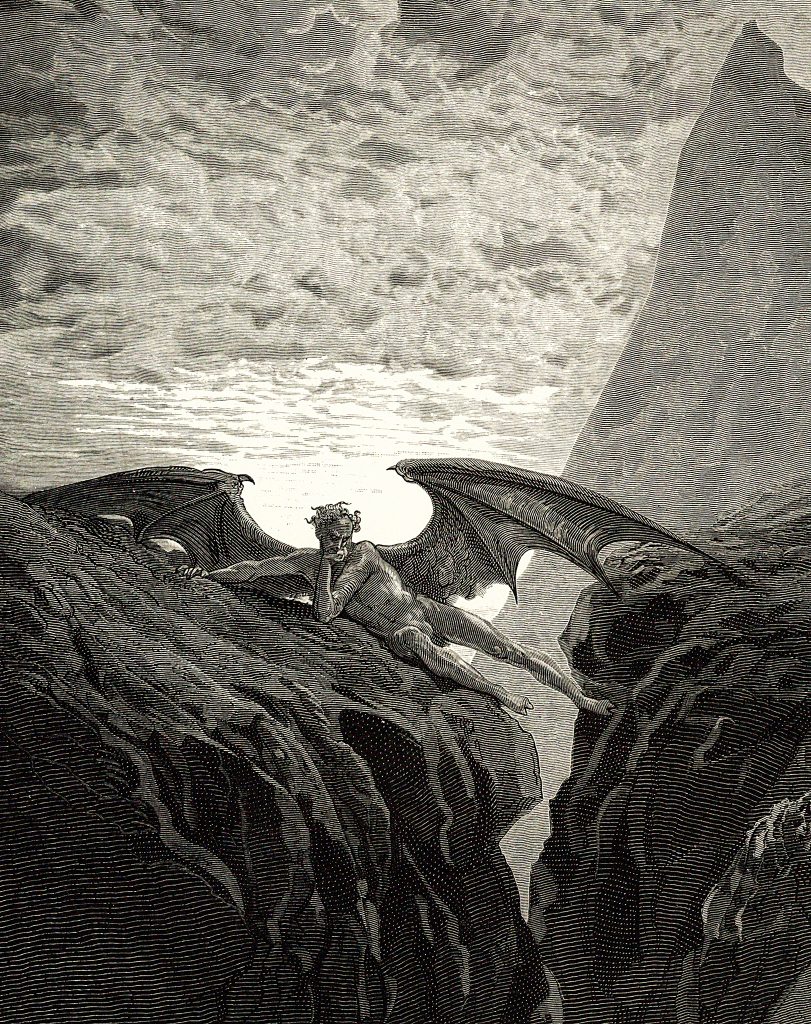
John Milton, the seventeenth century English poet, in the great epic poem Paradise Lost, has Satan as a major character. Milton makes him very eloquent, so much so that a century and a half afterwards the poet William Blake claimed that Milton was “of the Devil’s party without knowing it.” Blake thought that Milton had inadvertently made Satan the hero, and this character of Satan, who would rather reign in hell than serve in heaven, is a great and attractive protagonist. However, most scholars considering Blake’s claim believe that Milton knew exactly what he was doing – making Satan appear attractive and charismatic. Milton had lived through the overthrow of King Charles I and the English Civil Wars, and supported the Puritan Commonwealth, working as a diplomat. He then witnessed its descent into a centralised dictatorship under Oliver Cromwell, and its collapse after his death, with the Resoration and the return of the monarchy, the Book of Common Prayer, and bishops. Milton had had his hopes raised and confounded by eloquent politicians in Parliament and brilliant preachers, and seen it all go sideways.
We can see this in our world today and in the past. Politicians will use speeches and media to popularise of conspiracy theories, demonising those who are nor like them, and preying on the fears of those who are running into economic challenges. In an increasingly secular world the attraction of blood and soil, us against them, can be very appealing.
But, I tell you, they shall not, in the end, succeed, because evil is arrogant and stupid.
Take Hitler, for example. He was without question a charismatic figure who could win votes and attract fanatical followers. He and his propagandists understood how to use radio and film to popularise the Nazi party. His message that Germany had been stabbed in the back in the Great War went down well with the electorate, and sounded better than admitting that Germany’s military had lost the war. Blaming Communism and Jews for economic and nationalist problems meant that Germany did not have to accept responsibility for its own economic errors. When Hitler became Chancellor he gained control of what may have been the best military General Staff in Europe, and after massively enlarging the army and air force he was able to achieve some remarkable successes against Poland, Denmark, Norway, Belgium, the Netherlands, and France. Having defeated that old foe from the First World War, France, he believed that he was a military genius, and so attacked Soviet Russia and later declared war on the United States. But Hitler did not understand logistics or grand strategy. The United States was able to transform itself into a massive arms factory, supplying both itself and the Soviet Union, as well as keeping the United Kingdom supplied with food and supplies for it to carry on the fight. Even had the Germans somehow fought the Russians to a stalemate, or confined the western allies to France in 1944, the atomic bomb would have ended the war for Germany in defeat. And, of course, many of the people who worked on the Manhattan Project were Jewish refugees from Germany. Evil may see some spectacular success, but it will fail.
That’s one example. We can point to many other situations where totalitarians and dictators end badly, often at the hands of their own people. Think of Benito Mussolini, Muammar Gaddafi, Saddam Hussein, or Nicolae Ceaușescu. The French Marshal, President, and Nazi collaborator Philippe Petain, along with his Prime Minister Pierre Laval, were both condemned to death by a French Tribunal in 1945 (Because of his service in WW I, Petain’s sentence was commuted to life imprisonment; Laval was shot). Sometimes the evil leaders manage to die of natural causes, but in prison or in exile – again, think of Idi Amin, Hosni Mubarak, or Bashar Hafez al-Assad. The leaders of Germany and Japan in the Second World War were judged in the Nuremburg and Tokyo War Crimes Trials, and more recently military and politicians have faced war crimes tribunals for actions in Yugoslavia, Rwanda, and Sierra Leone, among others. The International Criminal Court has issued indictments against seventy-three individuals, including Vladimir Putin of the Russian Federation and person in sixteen other countries.
Of course, many evil people die in their beds, still in political power, but even then their legacies are challenged. Consider how quickly Stalinism was undone by his own party after he died, and the collapse of Russian communism in 1989-1990. Mao is revered as the unifier of China who established the Communist Party in power there, but since the overthrow of the Gang of Four after his death Mao has been roundly criticised for the failures of the Great Leap Forward and the Cultural Revolution.
The problem with evil is not whether it will ultimately be defeated – as Christians we know that it already has. As Martin Luther King so often pointed out, the arc of history bends towards justice. However, while evil will lose, and largely because evil leaders can be so stupid, but in the meantime the cost is so great. Good people, despite being fragile and sinful, must rise up time and again, speaking truth to power, countering the lies, emphasising human rights and democracy, championing empathy and kindness. The cost is in time and effort, and for some it involves imprisonment and even giving up one’s life, and it is a cost that Jesus was prepared to pay.
The attempt of Satan to tempt Jesus reminds me of the passage where Jesus tells his disciples, in Matthew chapter 20:25-27, “You know that the rulers of the gentiles lord it over them, and their great ones are tyrants over them. It will not be so among you, but whoever wishes to be great among you must be your servant, and whoever wishes to be first among you must be your slave”.
This is what Jesus is doing, having been driven by the spirit in the wilderness – voluntarily offering himself in service.
The tension, then, is not whether Jesus will resist the temptation, and it is not whether he will ultimately win the salvation of creation. We know he will resist, and we know he has won the victory. The tension is in our response. Will we turn and follow Jesus? Or are we so consumed with power and domination that we are more like the rulers of the gentiles? That is the challenge of Lent, to turn, and turn again. May we find ourselves on the side of the arc of history, working towards justice and righteousness in the servant rule of Christ. May God through the Holy Spirit empower us to know God’s will and to do it. May we always know that the love and wisdom of God will overcome the seductive temptation of evil. God wins.
I want to talk a bit about how I find that the philosophers Ludwig Wittgenstein (1889-1951) and Emmanuel Levinas (1906-1995) seem to say similar things about the nature of human language. The relevance to theology is that humans are required to use language, but often make claims in God-talk that need qualification. This will also lead us to consider some of the theme of deconstruction as described by Jacques Derrida (1930-2004), and how that relates to theology, the interpretation of scripture, and the activity of following Jesus the Messiah.
I think I need to do this in four parts. The first part talks generally about what philosophy is for those who have never bothered to read much about it, and I frame it as a personal account. The second part is biographies of Wittgenstein and Levinas, pointing out some similarities in the lives that may have contributed to their fashioning of philosophy. The third part is a discussion of their respective philosophies of language, noting the similarities. The last part draws out the implications for anybody of faith.
People who already know philosophy or are acquainted with Wittgenstein and Levinas may jump forward to the third part (when I have written it!).
A Career in Philosophy
In the autumn of 1981 I was a student on academic probation at the University of Toronto. I had arrived the year before with the intention of becoming a physicist, perhaps winning a Nobel Prize. I had arrived with two scholarships and had graduated at the top of my (admittedly small) high school. I thought I was hot stuff. However, between alcohol and an inability to adapt to the discipline of academic work in a university, I managed to fail not one but two courses. I thought of dropping out, but my father (who had had similar problems when he was at university) encouraged me to go back. Fortunately, the University of Toronto, a large, impersonal institution, had fairly generous terms for failing students, and kept me.
Me with my Bachelor of Arts Diploma outside Convocation Hall, Toronto, Autumn 1984,
One course that I had passed was a half course led by Professor Willard Oxtoby in Religion and Law. I do not think I did particularly well in it, but while doing the readings and a minimal amount of research for the essays I came across hints at the discipline of philosophy, which looked at all manner of things, but especially the meaning of life, and the place of religion and how philosophy may serve it or take it down. My brother Bill Scott had studied PPE at Oxford – Philosophy, Politics, and Economics – and from him I had gotten a whiff of what the field involved. In Religion and Law I heard references to Plato’s Cave, and Aristotle’s categories, as well as names like Kant and Hegel. So, for better or for worse, I started over, in the second year of a four year degree, changing my major to philosophy.
The University of Toronto then and now is possibly the best place in Canada to do a BA in philosophy, if only because it is so large that almost every branch of the academic field is taught there. Arguably McGill University in Montreal has some better known philosophers (Charles Taylor being the preeminent one), but I did not know that. At the age of nineteen I was remarkably ignorant.
Over the next three years I read through the history of philosophy:
The Greek Pre-Socratics – Thales, Anaximander, Heraclitus, Parmenides, and a few others. This was interesting because most of these authors are known to us only in quotations and fragments. They spanned the sixth to fourth centuries before the common era (“BCE”).
Plato – Some of this was really about Socrates, about whom Plato wrote, and who was usually the leading character in his dialogues, but after an early period Plato used his master’s voice to put forth his own ideas, particularly those about “forms” or “ideas” – the belief that the material world was less perfect than the world of numbers or ideals of justice, love, and truth, and that our mundane existence only replicates these as shadows.
Aristotle – I read his ethics and metaphysics, and to a lesser extent his categories.
Plotinus – I did a half-course in Neoplatonic thought, which was thought to influence early Christian theology.
I also did a course in the thought of Augustine and Thomas Aquinas, which introduced me to the two critical Christian thinkers from the Latin west of the 4th-5th century and 13th century, respectively.
My training then jumped to the early modern philosophers – Francis Bacon, who described an early form of the scientific method, and René Descartes. Then followed the Empiricists David Hume John Locke, and the Rationalists Baruch Spinoza and Wilhelm Leibnitz.
Immanuel Kant – mainly his metaphysics in The Critique of Pure Knowledge, which attempted to resolve the differences between the Rationalists and the Empiricists. I also read a bit of his ethics, but not enough.
G. W. F. Hegel – who reacted to the abstract, ahistorical analysis of reason of Kant by describing the world-spirit of Geist unfolding throughout history in the dialectic of thesis-antithesis-synthesis. Mostly I just read his Phenomenology of Spirit.
Karl Marx – the Soviet Union was still very much with us, and I had not yet heard of the reforms taking place in China, so it made sense to read some of the writings of Marx and Engels. As Marx claimed to be a materialist interpreter of Hegel, it also made sense to see what he made of the older German. I did not come away with any desire to be a Marxist.
My reading then jumped up into the 20th century, with a couple of courses in symbolic logic.
I also took a course in Wittgenstein’s philosophy, as found in his Tractatus Logico-Philosophicus (1921) and Philosophical Investigations (1953). As far as the mainstream of the Department of Philosophy at the University of Toronto was concerned, Wittgenstein was the culmination of the history of philosophy, and one could not be a modern academic philosopher in the 1980s without taking him into account.
I also did some courses on epistemology, aesthetics, and the philosophy of religion (which overlapped with the sociology of religion).
Finally, I did a course on Buddhist Philosophy, and I focused on the writings of Nagarjuna (c. 150-250 CE).
Now, anyone who knows anything about philosophy will notice a lot of gaps. For one, apart from that last course on Buddhist Philosophy, this was all very much Western Philosophy. There was a dim sense that there were other philosophies, perhaps from China or Japan or India, but these were never raised and seemed to have no impact on whatever it was that I was studying. So much for Islamic Philosophy, Chinese philosophies, Jewish Philosophy, much less Indigenous ways of knowing.
As well, apart from the Neo-platonists, I missed out on any of the Post-Aristotelians – the Stoics, the Epicureans, and Medieval philosophy was viewed just as various types of theology. I missed out on Thomas More’s Utopia and Bishop Berkeley’s radical idealism in Principles of Human Knowledge. I missed out on a whole bunch of 19th century Germans: Fichte, Schelling, Schleiermacher, Schopenhauer, and Nietzsche; some might suggest that I wasn’t missing much there, but I did notice this gap. I did not read Bertrand Russel or any of the other Anglo-American Analytical philosophers, or the Logical Positivists, except when they were commenting on Wittgenstein.
Another huge gap was what was described as Continental Philosophy – Henri Bergson, Edmund Husserl, Martin Heidegger, Jean-Paul Sartre, and Maurice Merleau-Ponty. It may well have been taught in corners of the Roman Catholic college of St Michael’s, but I never came across it nor was encouraged to go read it. Continental philosophy was the kind of thinking that I was directed to and told, “Whatever they are doing, don’t do that.”
The result of this at the end of my four year degree is that I did graduate in 1984 with some familiarity with many of the “greats” of western philosophy, but none of it went particularly deep. While I might have been accepted into a Master’s program in philosophy, no one was telling me to do so, and I was more interested at that time in preparing for ordained ministry. My training in philosophy set me up well for the three-year divinity degree, especially in theology, but I thought I was more or less done. In addition to philosophy, I also took some courses in religion, studying Islam and Hinduism.
Me and Frances with members of the Youth Group of St David’s Anglican Church, 1989
I earned a Master of Divinity in 1988, was ordained, and set off into parish ministry, dealing with Sunday liturgies and youth groups, baptisms, weddings, and funerals, as well as social action and administration. In 2002-2003 I took a year’s sabbatical and did another master’s degree, a Master of Theology at Harvard University’s Divinity School, where I encountered Feminist Theology, Black Theology, and the “dangerous” continental philosophy. On my own I began to read this man I had never heard of before, Emmanuel Levinas. In order to understand him, I had to read his major teachers – Edmund Husserl and Martin Heidegger. Thus I taught myself Continental Phliosophy. The nice thing about having by then done three degrees is that I could study on my own. More about Levinas in the next post, as well as my more recent re-placing of Wittgenstein in the history of philosophy.
In these forty days from Ash Wednesday to Easter we are invited “to observe a holy Lent by self-examination, penitence, prayer, fasting, and almsgiving, and by reading and meditating on the word of God.” As part of my Lenten discipline this year I intend to do some writing, which may fall into the categories of “self-examination” and “meditating on the word of God”, although some might see this as a bit of a stretch. Almost two years ago I went on a retreat to the Community of the Sisters of the Church in Gerrard’s Cross, Buckinghamshire, England, about an hour’s drive west of London. In my retreat discussions with Sister Hilda Mary CSC it was suggested that I should write out some of the things I was talking about, which were largely about my particular approach to faith in Jesus Christ and the triune God.
So that is what I intend to do. This will be theology, but not a systematic theology, because I am wary of grand narratives that seek or claim to explain everything, which is the impression I get whenever I see something that has the title of “systematics”. While impressed by theologians like Thomas Aquinas with his two Summas, or Karl Barth with Church Dogmatics, I tend to approach the Christian faith from various directions and perspectives. Perhaps we could call this Unsystematic Theology, in that I do not see any overarching idea whose implications are thought through the various fields of Christoan thought. Or, perhaps, Eclectic Theology, because it draws here and there in the tradition. Sarah Coakley, the English theologian who has taught in both the UK and in the USA, if I remember correctly, describes systematic theology as that which relates one theological idea or set of ideas to one another. I think I do try to do that, although I am pretty sure that I have not adopted her approach of theologie totale.
Here are some of the things which I want to write about:
How the two philosophers Ludwig Wittgenstein (1889-1951) and Emmanuel Levinas (1906-1995) overlap when it comes to their understanding of language, and what that might mean for God-talk.
Does God have a mind, or is that simply more anthropomorphism? If the latter, what, then, does it mean to say that God “thinks this” or “desires that”? What do we understand about the will of God? Is God “personal”? (You can see how one’s philosophy of language may be important).
How does the uncreated Divine interact with Creation?
How do I come to know God’s will for me?
In our post-enlightenment world where science has given humanity great power without requiring the concept of God, why should anyone bother with Christianity (or any other religion)? Or, to put it another way, how can one be a Christian in an individualistic, secular age?
To what extent can we rely on the Scriptures? If we use historico-critical methods, can we still have faith that Jesus said anything other than “Amen” and “Abba”?
How do we resolve ethical disputes, such as the equality of women within the church and society, racism against people who are different from us, discrimination on socioeconomic grounds, and providing redress or reparations for the harms done in colonialism (including slavery, taking land from indigenous peoples, and attempting to assimilate or kill off indigenous peoples)?
How does matter and the spiritual relate? If both are created, is there really any distinction? Is everything just matter?
These probably sound rather abstract, but they are the kinds of things somebody with four degrees in philosophy, divinity, and theology will think about. We’ll see if I get anywhere.
And I tell you, make friends for yourselves by means of dishonest wealth so that when it is gone, they may welcome you into the eternal homes . . . No slave can serve two masters, for a slave will either hate the one and love the other or be devoted to the one and despise the other. You cannot serve God and wealth. Luke 16:9, 13.
Many years ago I read this passage as the gospel at St Peter’s Church on North Pender Island, and I have no memory of what I preached about, but I do recall that at the church door after the service one of the prominent parishioners questioned the translation. “Is it really dishonest wealth?” he asked, and I said, “Well, in the original Greek it appears to be dishonest mammon, which seems to be an Aramaic word that stands for money.” Of course, he wasn’t asking about the translation of the word mammon as wealth, but of the word “dishonest”. Was wealth really dishonest? Not that riches could not be abused, but do they not represent the power to do things and benefit people? Wealth was perhaps best regarded as neutral, and what one did with it was the issue. If one was corrupted by the power of great wealth, that said more about the individual rather than money as such.
And there is something very attractive about wealth, right? In Canada I spent nine years as a member of the Pension Committee of the Anglican Church of Canada, overseeing some CAD $800 million of assets. I was quite chuffed with that. When I moved to the Church of England it was suggested to me that I could become a member of the Church Commissioners, who oversee some £11 billion. That sounded quite interesting to me, and so when a vacancy opened on the Board of the Church Commissioners for a member of General Synod I submitted my name and qualifications . . . and in the election I came dead last, something like fourteenth out of fourteen. Oh well so much for my designs on administering great wealth.
Have you heard of the Church Commissioners before? If you are a member of the Church of England, you probably should know something about them. According to the Wikipedia article on them,
The Church Commissioners is a body which administers the property assets of the Church of England. It was established in 1948 and combined the assets of Queen Anne’s Bounty, a fund dating from 1704 for the relief of poor clergy, and of the Ecclesiastical Commissioners formed in 1836. The Church Commissioners are a registered charity regulated by the Charity Commission for England and Wales, and are liable for the payment of pensions to retired clergy whose pensions were accrued before 1998 (subsequent pensions are the responsibility of the Church of England Pensions Board).
Queen Anne’s Bounty First Charter (1704) from Lambeth Palace Library
The website at the Church of England highlights the following key numbers:
There are 33 Commissioners.
They manage £11.1 billion in assets
They have committed to distribute £1.2bn to the Church of England in the current funding period (2023-25). This distribution is managed by a subcommittee of the Archbishops Council, with consultation from General Synod.
The Church Commissioners for England contribute towards around 20% of the annual running costs of the Church of England.
Now, I think there may be a connection with the Parable of the Dishonest Steward and the issue of dishonest wealth. Questions arose in the past couple of decades about where the wealth of the Church Commissioners came from. Queen Anne’s Bounty was created in 1704 by parliament during the reign of Queen Anne (you may remember she was played by Olivia Coleman in the 2018 movie The Favourite, a somewhat unhistorical representation of the monarch). The original income was based on the annates monies: ‘first fruits’ (the first year’s income of a cleric newly appointed to a benefice) and ‘tenths’ – a tenth of the income in subsequent years. The money was invested and the income used to augment the incomes of clergy in poor parishes. Essentially, then, it was a program of income redistribution. By 1815 it was supplementing the income of some 3300 parishes in England and Wales.
It was in the investments, perhaps, that the monies became dishonest, for it was found after investigation by historians that that by 1777, Queen Anne’s Bounty had investments worth £406,942 (potentially equivalent to around £724m in today’s terms) in the South Sea Company, a company that transported slaves. The results of the investigation were published in 2023 as Church Commissioners’ Research into Historic Links to Transatlantic Slavery. The report estimated that the South Sea Company transported 34,000 slaves “in crowded, unsanitary, unsafe and inhumane conditions” during its 30 years of operation. As well, Queen Anne’s Bounty received donation from wealthy benefactors, many of whom made their money through the slave trade or the labour of enslaved persons in the Caribbean and British North America. It is thought that the South Sea Company transported some 34,000 slaves from Africa to South America, the Caribbean, and the British colonies in North America. The conditions of transportation were crowded and unsanitary, with a high mortality rate.
This means that something like 8% -10% of the assets of the Church Commissioners is derived from the unethical exploitation of enslaved human beings. What are we to do with this money? Is it right for us today in the Church of England to benefit from slavery two centuries ago?
The Church Commissioners judged that it was not. As a result they have decided to set up a fund to eventually be of some £100 million, and the income from that fund will be used to fund projects that would aid communities harmed by transatlantic chattel slavery. They are inviting other organisations who have similar histories to join with them, perhaps building the fund up to one billion pounds sterling. Now, I do have concerns about this endeavour, now named “Project Spire.” I am concerned that the Commissioners continue to control the funds, and I want to know what the criteria are for accepting applications for grants. I want to know where those grants are going – just the UK, or also in the Americas and in Africa? How will the Commissioners ensure that the grants are used for the intended purposes? Is £100 million enough? However, I laud the intention and wait with patience for the details.
Of course, there has been some push back. A few conservative historians in the UK, the type that argue that there was nothing wrong with British Colonialism, have called into questions the methodology of the forensic accountants and historians in the above-mentioned report. Questions were asked in Parliament. The Commissioners and the people who did the actual research have defended their work and approach, arguing that their critics.
In continuing to make false claims, refusing to correct mistakes, and cherry-picking arguments, our opponents seem tone-deaf to the theological underpinnings of our moral obligations. Our work focuses on how a faith-based, Christian investor addresses the issue of historic links with a crime against humanity that continues to impact our society to this day. Our critics frame this as a culture war issue — in truth, we are acting in faithful service of the Gospel. (Church Times July 11, 2025)
I strongly believe that as a Church we need to be aware of where our resources come from, and be careful in its administration. As an institution that has been around for twenty centuries we have a lot of baggage. The point of Project Spire is not to make anybody guilty, but to be responsible, and to answer the question, “Given what we know, what is our responsibility?”
This takes me back to the familiar parable of the Good Samaritan. There is an interesting shift in the rhetoric in the story. The person approaching Jesus asks him, “Who is my neighbour?” Jesus turns it around and says, “Which of these three proved a neighbour to the man in the ditch?” Obviously it was not the priest or the Levite, but the Samaritan. Jesus says, “Go and do likewise.” Rather than try to limit our responsibility, we need to ask how we are to be good neighbours. Continuing to benefit off the trauma of slavery is not one of them.
A sermon preached on 14 September 2025 at the Anglican Church of St Thomas the Apostle, Kefalas, Crete, Greece, a chaplaincy of the Diocese in Europe in the Church of England.
In the movie When Harry met Sally (1989) Harry (played by Billy Chrystal) and Sally (played by Meg Ryan) have the following conversation at the wedding of their close friends Jess and Marie. Harry is the best man and Sally is the maid of honour. It’s important to know that Sally and Harry have had a falling out and haven’t spoken for weeks.
Harry Burns: You know how a year to a person is like seven years to a dog? Sally Albright: Is one of us supposed to be a DOG in this scenario? Harry Burns: Yes. Sally Albright: Who is the dog? Harry Burns: You are. Sally Albright: I am? I am the dog? I am the dog?
I thought of this passage while reading the gospel this morning:
Which one of you, having a hundred sheep and losing one of them, does not leave the ninety-nine in the wilderness and go after the one that is lost until he finds it? . . . Or what woman having ten silver coins, if she loses one of them, does not light a lamp, sweep the house, and search carefully until she finds it?
In these scenarios, you are the coin, you are the sheep. In the Kingdom of Heaven God is portrayed in these two short parables as anxious and desperate, something I preached about nine years ago when I was the interim priest in charge at the Anglican Church of St John the Baptist in Cobble Hill, South Cowichan, on Vancouver Island in British Columbia. You can read what I preached then in the link, but today I want to focus on being lost.
We are the Lost Coin. We are the Lost Sheep.
There are so many ways in which we might consider ourselves to be lost.
Spiritually
We might find ourselves lost spiritually, which is often the only way these two parables are read. Perhaps we have lost faith in God, or never had it. Perhaps we have lost the presence of God in our lives, as Mother Teresa experienced. Perhaps it is an intellectual problem leading to a spiritual one. Many divinity students arrive in theological schools with a naive idea of the scriptures, and are startled to encounter historico-critical methods that reveal the human nature of Biblical texts and call into question their inerrancy and infallibility; reconstructing a more complex understanding of divine inspiration in conjunction with an understanding of salvation being through belief in Christ and not in a particular understanding of scripture usually follows. Then again, perhaps we have experienced abuse in the church, and the way in which this abuse happened and the way it was dealt with by officers of the church may affect one’s faith. In the gospels the lost are often correlated with sinners such as sex workers, publicans, tax collectors, and so forth, although the elites, such as Pharisees and scribes, the Sanhedrin, and wealthy Jewish landlords, are often described as blind and misleading, although they believed themselves in the right. However, they may also be those who have been oppressed by the powers that be, including religious authorities. Through no fault of our own, we may find ourselves estranged from God. Thus, whether we are at fault or someone else has so traumatised us that we are removed from the divine, we are all lost and in need of being found by God. We believe that in Christ we are found – God takes the initiative and we respond.
Mentally
We may be lost mentally, through no fault of our own. Paul writes in his First Letter to Timothy
I was formerly a blasphemer, a persecutor, and a man of violence. But I received mercy because I had acted ignorantly in unbelief
Paul has a very clear view of what he was, and while his First Century context does not allow for him to psychologise himself, he understands the grace that he has received as something granted because he was just ignorant and unbelieving.
We may also be caught up in alcoholism or other addictions, which is a range of diseases that afflicts perhaps up to 25% of the population. It is hard to get spiritual when one’s highest power is alcohol, cocaine, or opioids.
We may be traumatised and perhaps have lost confidence in ourselves and others, and have developed behaviours that impede us accepting the good news and to trust in a generous God.
Politically
We may find ourselves having lost faith in the political systems and being filled with despair. Part of this is undoubtedly a function of both our traditional media and more recent social media. The traditional media always seemed predisposed to highlight bad news – “It it bleeds it leads” is an old journalistic adage. One only needs to have read the headlines of the London dailies to see how vituperative the authors and publishers can be. Likewise, social media takes up all the oxygen in the room with false news and conspiracy theories, and makes the old newspapers look gentlemanly in comparison.
And so we we are painfully aware of what is going wrong in politics and diplomacy, and of the human cost in lives and degradation. We do not hear the good news – the number of people that have been lifted out of extreme poverty, the general increase in wealth in the post-war era, or the extent to which violence in war has become the exception and not the rule throughout the world. Bad news generates passion and votes in a way that sunny messages do not, and so manipulative autocrats get people to act on their fears and not the better angels of their nature. And so perhaps we give up, failing to engage in civil action or even vote.
Environmentally
And associated with political despair is concern for the planet, something which seems to have disappeared in the past few years. Whether it is the rise of governments that deny climate change, or, as in my home country of Canada, regimes that seek to expand the sale and distribution of petroleum products, it is a depressing time. Here on Crete we see olive farmers having to harvest their trees earlier and in warmer climates. The snowfall on the mountains seems to be less and less, and the temperature in Athens in the summer seems to be climbing.
The White Mountains (Λευκά Όρη) from St. Thomas’s. Photo by David Hurley.
This environmental degradation has been going on a long time. We look out from this Tabernacle and see a beautiful scene of valleys and mountains, but the fact is we are looking at a view that has been transformed by human beings over the millennia. In the period of the Roman Empire the number one export was not olive oil, but lumber. We do not think of this island of Crete as being heavily forested, but it was, and the trees here served to build the apartments in Imperial Rome and the ships of the fleets that brought wheat from Egypt and North Africa. After the trees went, erosion wore down the soil, so that trees will no longer grow all the way to the tops of the mountains. The plains of Chania and Rethymno, which used to be fields with various grains such as wheat and barley, and now paved over with concrete for Cretans and tourists, creating situations that result in flash floods.
Physically
Of course, most of us here are older people and we may be entirely too caught up in the ravages of age. I spent three weeks earlier this year on sick leave, and some of us here are experiencing cancer in ourselves or in our close family. We literally do not bounce back like we used to, as I found out when I hurt myself jumping down from one path to another in Gibraltar in early March, resulting in a need for crutches. We eat the wrong things, carbohydrates and junk food, too much fat and sugar, and develop diseases such as Type II diabetes. We are far too sedentary. We may be lost in bad behaviours that we could get away with as young adults but are not reaping consequences in chronic conditions. Our environment plays into this, of course; microplastics are everywhere, including our brains, and we really have no sense of what effects they are having on us.
I Once Was Lost, But Now am Found
The good news is that despite all these ways of being lost, God is at work in the world and among us. God has not abandoned the world but in the person of Jesus Christ has come among us, and deigns to eat and drink with tax collectors and sinners. Every Sunday we are bidden to eat at his table and be refreshed for the coming journey, to hear his word and be inspired to be made new in the image of Christ. The Christian hope is an impossible hope, in taht it is rooted in the belief that Christ rose from the dead. It is a hope in the face of despair, and promise of being found despite the sense of being lost.
We believe that in Jesus God has already acted to rescue us from being lost politically, spiritually, physically, mentally, and environmentally. We are called to open ourselves to God’s healing grace and be made different from what we were. The Kingdom of this World is by no means the Kingdom of God, but as part of the Body of Christ we can begin the work of making it so, bot individually and collectively. You were a lost coin, but now you are found. We were lost sheep, but the shepherd has collected us. Heaven rejoices, and so should we.